Just kidding, nothing about left here. Nor right really.
However, amidst the crappy news around, this is a bit of hope: Classical music healing.
There are some great posts up at Composing Thoughts about the Pulitzers and the start of FIVE WEEKS of world premieres in Central PA! Check it out. And, of course, tune in Sunday nights at 7pm (available online to listen as well!)
Tuesday, April 17, 2007

Friday, April 13, 2007
Good blur
It's been a week that has past by quite quickly, no doubt aided by my 37th birthday. Thanks for all of the wishes and gifts, ranging from cards, dinners, drinks, hats, and even some new music!
I started this post on Friday afternoon and got taken out...and now the weekend has been a blur too. More on it all really soon. Pictures too!
I started this post on Friday afternoon and got taken out...and now the weekend has been a blur too. More on it all really soon. Pictures too!
Wednesday, April 11, 2007
Poetic
The latest Danse Macabre is now out, see it here. While it focuses on poetry, my friend Adam managed to include me with a fun reworking of a composer interview I did - enjoy!
Tuesday, April 10, 2007
Just in
It's official!
 Read the article here: http://www.earthtimes.org/articles/show/50221.html
Make your voice heard now and vote in another radio poll...Vote for your favorites now at WITF's 89.5 Classix! (Might I suggest to write in Jennifer Higdon, Augusta Read Thomas, Walter Mays, Joan Tower, Steven Stucky or Paul Moravec?)
Monday, April 09, 2007
Talent quest
How was your easter? Mine was good thanks.
I spent the weekend dog-and-house-sitting for friends on a trip in the Carribbean. It was a blast. The springer spaniels were great and gave me a "dog fix" I needed.
I also produced a friend's entry for the Public Radio Talent Quest and enjoyed her company. I had a chance to chat with my parents, and with another high school friend who we hadn't touched base in a year or so.
This week will be busy as Quartetto Gelato visits the midstate, I turn 37, give a talk for the AAUW, and go to NYC over the weekend.
I've also posted my latest interview with Arnold Steinhardt here (and you might remember our discussion last year in Lancaster), and this week's composer on Composing Thoughts is John Harbison - there's some good extras here. Enjoy!
I spent the weekend dog-and-house-sitting for friends on a trip in the Carribbean. It was a blast. The springer spaniels were great and gave me a "dog fix" I needed.
I also produced a friend's entry for the Public Radio Talent Quest and enjoyed her company. I had a chance to chat with my parents, and with another high school friend who we hadn't touched base in a year or so.
This week will be busy as Quartetto Gelato visits the midstate, I turn 37, give a talk for the AAUW, and go to NYC over the weekend.
I've also posted my latest interview with Arnold Steinhardt here (and you might remember our discussion last year in Lancaster), and this week's composer on Composing Thoughts is John Harbison - there's some good extras here. Enjoy!
Friday, April 06, 2007
Another view
Thursday, April 05, 2007
Five Things about Blair McMillen
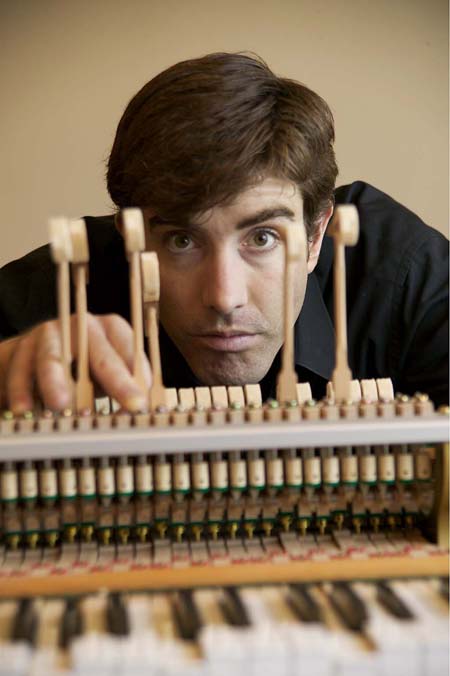 I caught a recital at the Italian Academy at Columbia University (officially the Italian Academy for Advanced Studies in America) last night in NYC. The program was part of the "Music for a New Century" - Works composed since 2000, with pianist Blair McMillen.
1. I thought I might see one or two of the composers at the concert - after all, Blair is the pianist for the DaCapo Players, so I wondered. As I was out front enjoying a cigarillo, Joan Tower showed up with friends, and we chatted. Later, inside, Derek Bermel sat behind me and we chatted - he pointed out Anthony Tommasini and Fred Hersh to me.
2. The program showed no intermission, and really didn't need one - the five pieces were diverse but not terribly long. Blair took some time in between, which was just right. The order was delightful too: Steven Stucky, Barbara White, The new Goldberg variations (including the original aria and 4 new variations by Stanley Walden, Fred Hersh, Mischa Zupko, and Derek Bermel), Marco Stroppa and Joan Tower.
3. Listening to piano works by composers you know is certainly interesting, especially when it is their chamber music or orchestral scores you are familiar. I have new respect for many of them now - hmmm, maybe new insight is a better word, I still respect them.
4. This program is one of the finest treats I've had, and it was free. While the 50 or 60 people in the audience were appreciative and didn't make it less appealing, I'm a little suprised that it wasn't better attended. Why is that?
5. Blair included two encores, "In the rain" by Barbara White, again from her "Reliquary" and "Sexy" from Kyle Gann's "Private Dances" - both short and sweet. It was a fitting end to a rockin' recital.
The next concert is May 2nd, 2007 with Kathleen Supove and Jennifer Choi. Email Rick Whitaker or call him at 212 854 1623 for free tickets (and tell him John Clare sent you!)
Last 24...
So, in the last 24 hours, I've interviewed two composers in NYC (Peter Schickele and Eric Ewazen); had a great lunch at a vietnamese place; stayed for $80(!!!!!) overnight; ate at one of my fave italian places (joe g's on 56th); saw blair mcmillen tear up the keyboard at columbia (for free!) and there were 4 of the composers on the program in attendance. Oh, and I brought back a dozen & a half bagels for my coworkers.
whew!
I love my life.
whew!
I love my life.
Tuesday, April 03, 2007
Would it help?
Would it help if we ran away faster?*
This story just struck me funny...go figure. Imagine if Amtrak had such speedy trains, what my travel would be like between Harrisburg, Philly, DC and NYC?!
*Thank you Monty Python!
This story just struck me funny...go figure. Imagine if Amtrak had such speedy trains, what my travel would be like between Harrisburg, Philly, DC and NYC?!
*Thank you Monty Python!
Monday, April 02, 2007
Five Things about Alarm Will Sound
I heard the "farewell" concert at Dickinson College of the ensemble in residence, Alarm Will Sound (AWS) Saturday night at Rubendall Hall.
 1. The evening was stellar, from precise and moving performances to educational activities where the students were playing alongside the performers (in a new work nonetheless!) to a killer reception afterwards.
2. Michael Gordon has a far better sense of rhythm than I do. So does Benedict Mason. In fact, AWS does in general! Some great funky stuff - catch them when they come to your town - and buy their cds.
 3. The premieres the whole evening were superb, and the program itself was so well crafted. I enjoyed "Plays Well With Others" by Robert Pound - who led his work with panache and sparkle.
4. John Orfe's Chamber Symphony was particularly good, and his knowledge of his colleagues shows in the writing (he's the pianist in AWS). Of course, his company and friendship with Ezra Ladermann and John Adams doesn't hurt I'm sure. The work has a Mahlerian feel with 21st century good taste - that is to say, it is a serious and virtuosic work which I long to hear again.
 5. The encore was from their Aphex Twin cd, conceived at Rubendall Hall a few years ago. It was delightful, but I would have also had them encore even more - I almost shouted "Da Capo!" at the end of Animals and the Origins of Dance. (The musicians all leave the stage, where pre-recorded sounds are heard along with off stage playing! pictured left.)
I'm looking forward to hearing AWS again live and on future cds!
[You can hear and see interviews with Robert Pound and John Orfe here.]
BTW, my friends joined me: Zach, Bob and Sue - we had great seats!


 1. The evening was stellar, from precise and moving performances to educational activities where the students were playing alongside the performers (in a new work nonetheless!) to a killer reception afterwards.
2. Michael Gordon has a far better sense of rhythm than I do. So does Benedict Mason. In fact, AWS does in general! Some great funky stuff - catch them when they come to your town - and buy their cds.
 3. The premieres the whole evening were superb, and the program itself was so well crafted. I enjoyed "Plays Well With Others" by Robert Pound - who led his work with panache and sparkle.
4. John Orfe's Chamber Symphony was particularly good, and his knowledge of his colleagues shows in the writing (he's the pianist in AWS). Of course, his company and friendship with Ezra Ladermann and John Adams doesn't hurt I'm sure. The work has a Mahlerian feel with 21st century good taste - that is to say, it is a serious and virtuosic work which I long to hear again.
 5. The encore was from their Aphex Twin cd, conceived at Rubendall Hall a few years ago. It was delightful, but I would have also had them encore even more - I almost shouted "Da Capo!" at the end of Animals and the Origins of Dance. (The musicians all leave the stage, where pre-recorded sounds are heard along with off stage playing! pictured left.)
I'm looking forward to hearing AWS again live and on future cds!
[You can hear and see interviews with Robert Pound and John Orfe here.]
BTW, my friends joined me: Zach, Bob and Sue - we had great seats!
I also had the great pleasure to finally meet Mel and Matt:
Read Melissa's blog here. Turns out she knew a player from high school and I knew the cellist who was subbing previously...small world!
Friends Focus

 It's been a wacky week, and Friday was a delight...I attended a cocktail party and then art opening at the Mantis Collective in Harrisburg.
Below are some scenes from the relaxing and fun event.


Wednesday, March 28, 2007
Delightful article
The latest installment from New Music Box on economics is a great read. Find it here. Enjoy!
Tuesday, March 27, 2007
Congrats
It's just been announced:
THE AMERICAN MUSIC CENTER
ANNUAL MEETING AND AWARDS CEREMONY
2007 HONOREES
Letter of Distinction: T.J. Anderson, John Corigliano, and Ralph N. Jackson
Trailblazer Award: eighth blackbird
MONDAY MAY 7th
5:00-7:00 PM
Chelsea Art Museum
556 West 22nd Street (at 11th Avenue)
New York City, NY 10011
Check out their site to find out more and to attend (deadline is April 25th!)
THE AMERICAN MUSIC CENTER
ANNUAL MEETING AND AWARDS CEREMONY
2007 HONOREES
Letter of Distinction: T.J. Anderson, John Corigliano, and Ralph N. Jackson
Trailblazer Award: eighth blackbird
MONDAY MAY 7th
5:00-7:00 PM
Chelsea Art Museum
556 West 22nd Street (at 11th Avenue)
New York City, NY 10011
Check out their site to find out more and to attend (deadline is April 25th!)
Monday, March 26, 2007
Lettah to the Editah
Nice to see coverage of Concertante by the local Harrisburg paper this last week:
http://www.pennlive.com/patriotnews/stories/index.ssf?/base/entertainment/1174795814114680.xml&coll=1
and
http://www.pennlive.com/patriotnews/stories/index.ssf?/base/entertainment/117467434170840.xml&coll=1
also a link to the Thursday promo piece on Mansurian and Ara:
http://www.pennlive.com/patriotnews/stories/index.ssf?/base/entertainment/117448710253580.xml&coll=1
It was interesting to read Mr. Dunkel's take on the flyer announcing the dates of the group's season. So the board president, Elizabeth "Bebe" Mullaugh has written the following to the Patriot News:
re: David Dunkle's review of Concertante (3/25/2007)
While pleased to see David Dunkle's review of Concertante's March 24 concert in Sunday's Patriot-News, as president of Concertante's board of directors, I am concerned that the focus on Concertante's "intention to leave Whitaker" may have left readers with an inaccurate impression of Concertante's relationship with one of our region's best cultural institutions.
Whitaker Center for Science and the Arts is a tremendous asset in our community and Concertante is honored to have been a resident company there since 1999. Whitaker's Sunoco Theatre is an excellent space for amplified music, musical theater productions and opera, however its size and acoustics make presentation of chamber music by small ensembles less than perfect. Concertante and the terrific staff at the Sunoco Theater have worked hard to address these challenges, including experiments with placement of the acoustical shell and even placing the entire audience on the stage, all in the interest of creating a compelling concert-going experience.
After much consideration, the ensemble decided to present two of its 2006-2007 concerts at the Rose Lehrman Arts Center at Harrisburg Area Community College. At the September concert, the audience and the musicians were extremely pleased with the intimate space and acoustics of the Rose Lehrman auditorium. Based on that experience, the board and ensemble decided to schedule all of Concertante's 2007-2008 dates there.
Saturday evening's "announcement" referred to by Mr. Dunkle was merely a program insert alerting audience members of our 2007-2008 dates and concert location. Whitaker Center has long been aware of the move and Concertante's relationship with Whitaker Center remains cordial and open. While we will miss our association with Whitaker as a resident company, we believe that being on campus at HACC will offer the added opportunity to attract students and faculty to the concerts, reflecting Concertante's mission to bring the beauty of live chamber music to increasingly diverse audiences. Concertante's move to Rose Lehrman is a logical one, not driven by economics or ill-will, simply a commitment to the music and our audience.
Elizabeth P. Mullaugh
McNees Wallace & Nurick LLC
100 Pine Street
P.O. Box 1166
Harrisburg, PA 17108-1166
There may be further coverage...and yes, for those playing at home, and for full disclosure, I'm a board member of Concertante. :)
http://www.pennlive.com/patriotnews/stories/index.ssf?/base/entertainment/1174795814114680.xml&coll=1
and
http://www.pennlive.com/patriotnews/stories/index.ssf?/base/entertainment/117467434170840.xml&coll=1
also a link to the Thursday promo piece on Mansurian and Ara:
http://www.pennlive.com/patriotnews/stories/index.ssf?/base/entertainment/117448710253580.xml&coll=1
It was interesting to read Mr. Dunkel's take on the flyer announcing the dates of the group's season. So the board president, Elizabeth "Bebe" Mullaugh has written the following to the Patriot News:
re: David Dunkle's review of Concertante (3/25/2007)
While pleased to see David Dunkle's review of Concertante's March 24 concert in Sunday's Patriot-News, as president of Concertante's board of directors, I am concerned that the focus on Concertante's "intention to leave Whitaker" may have left readers with an inaccurate impression of Concertante's relationship with one of our region's best cultural institutions.
Whitaker Center for Science and the Arts is a tremendous asset in our community and Concertante is honored to have been a resident company there since 1999. Whitaker's Sunoco Theatre is an excellent space for amplified music, musical theater productions and opera, however its size and acoustics make presentation of chamber music by small ensembles less than perfect. Concertante and the terrific staff at the Sunoco Theater have worked hard to address these challenges, including experiments with placement of the acoustical shell and even placing the entire audience on the stage, all in the interest of creating a compelling concert-going experience.
After much consideration, the ensemble decided to present two of its 2006-2007 concerts at the Rose Lehrman Arts Center at Harrisburg Area Community College. At the September concert, the audience and the musicians were extremely pleased with the intimate space and acoustics of the Rose Lehrman auditorium. Based on that experience, the board and ensemble decided to schedule all of Concertante's 2007-2008 dates there.
Saturday evening's "announcement" referred to by Mr. Dunkle was merely a program insert alerting audience members of our 2007-2008 dates and concert location. Whitaker Center has long been aware of the move and Concertante's relationship with Whitaker Center remains cordial and open. While we will miss our association with Whitaker as a resident company, we believe that being on campus at HACC will offer the added opportunity to attract students and faculty to the concerts, reflecting Concertante's mission to bring the beauty of live chamber music to increasingly diverse audiences. Concertante's move to Rose Lehrman is a logical one, not driven by economics or ill-will, simply a commitment to the music and our audience.
Elizabeth P. Mullaugh
McNees Wallace & Nurick LLC
100 Pine Street
P.O. Box 1166
Harrisburg, PA 17108-1166
There may be further coverage...and yes, for those playing at home, and for full disclosure, I'm a board member of Concertante. :)
Five in Six
Well, the answer could be 1.2...but it's not. I interviewed five composers in six days:
Pierre Jalbert on Tuesday.
Roxanna Panufnik on Thursday.
John Orfe and Tigran Mansurian on Saturday.
Derek Bermel on Sunday.
Plus more this week! What's that saying about March, in like a lion? No time, gotta go prepare for another interview...
Pierre Jalbert on Tuesday.
Roxanna Panufnik on Thursday.
John Orfe and Tigran Mansurian on Saturday.
Derek Bermel on Sunday.
Plus more this week! What's that saying about March, in like a lion? No time, gotta go prepare for another interview...
Get out the vote
Yesterday's post also reminded me about the NSO touring Kansas...but I forgot to post the link to their blog...here it is, enjoy! More on the NSO and modern music soon - but for now, take a look at their May 17-19 concerts and you'll see changes, doh!

I also forgot to tell you that WITF has started it's 89.5 Classics, so go now and vote! You can vote weekly in the categories and you can also write in your favorite piece, if it's not shown in the poll. It'd be nice to have some "winners" in modern music scene!!!!
Sunday, March 25, 2007
At the speed of life
 I've been extra busy these days, and have had a little bit of time to think about it.
If you know me at all, you know that I adore the music of Sir Andrzej Panufnik. Wednesday I met his daughter, Roxanna who is a talented composer as well. Thursday we had an interview for Composing Thoughts, and last night I heard her Love Abides premiered in Philadelphia. It was sublime.
[picture of Roxanna and John before the concert]
It was stellar to meet her, and hard not to ask questions about Andrzej. I did work in a question about growing up with a artistic family and a father who was a composer. You'll have to tune into the show to find out the answers to that and much more.
Yesterday was filled also with other interviews (see the previous post below!) and as I was driving I could hear, but not see the big screen simulcast, of The Barber of Seville with former fellow WSU student Joyce DiDonato. Of course what I heard was sublime. Friends called at intermission and we talked about how stunning she was! I hope they encore it, I'd love to see it again, and may just have to go see one of the repeat performances live at the Met.
Here's a tidbit about Joyce and Un voce poco fa. I used to put together alot of concerts - especially in college, I would even conduct quartets given the chance. I began my debut with Copland's Fanfare for the Common Man to open the very first WSU Contemporary Music Festival. I also started the Wichita Chamber Orchestra, besides the Virtuosi di Wichita State - we'd do Haydn Symphonies, the gorgeous middle movement of Gorecki's Third Symphony and once I did the Marriage of Figaro for horn choir - hey, like I said I would do anything to conduct.
On one such outing with the first concert of the Wichita Chamber Orchestra, we did a concert with myself, Robert Glasmann guest conducted and our soloist was Joyce Flaherty (now DiDonato.) The program opened with Rossini's Italian Girl in Algiers Overture. Then Joyce sang Una voce poco fa from the Barber of Seville. Glasmann conducted Barber's Adagio (I sat in on viola!) and then we ended with Beethoven's First Symphony.
At the first rehearsal (all of the music was on loan from WSU's library) early in June before everyone left for summer festivals, we read the Rossini Overture. Bob was around for the Barber and Joyce was ready for the Rossini. Call me naive, but I hadn't realized there were two versions of the aria, one for soprano and one for mezzo. We started the aria, and Joyce stopped me. "What is that? What key are you in?!" Whoops. WSU only had the soprano version!
She sang it nevertheless. And with all the charm that is Joyce/Rosina.
Yesterday driving I smiled when Joyce was singing at the Met, and reminded me of 16 years ago on the summer day at Duerkson Fine Arts Center in the orchestra room. Bob laughed and shook his head at me. Guess that's one reason I never went into conducting...those small details.
BTW, you can hear and see Joyce on YouTube here. (in the right versions!)
Saturday, March 24, 2007
Putting busy in business
So my travels continue, fast and furious. Had a great interview with Roxanna Panufnik Thursday, then last night a yummy new pizza place discovery for me in Lemoyne with a friend before catching Concertante at Suba - if you were there, you had a blast, if not you're a square! Fear not, they are playing a killer concert tonight at Whitaker Center - go!!!!
I'm about to go interview the composer Tigran Mansurian this afternoon, then go to Philly for Love Abides premiere with Roxanna.
Tomorrow I talk with Derek Bermel in Philly as well.
 I just finished an interview at WITF with John Orfe, the pianist from Alarm Will Sound - what a treat. His Chamber Symphony is premiered next Saturday at Dickinson - another don't miss concert. Here we are after the interview - keep an ear out for it over on Composing Thoughts, as I'll be starting a world premiere section!
For more concerts going on, check out Dick Strawser's blog.
I'm about to go interview the composer Tigran Mansurian this afternoon, then go to Philly for Love Abides premiere with Roxanna.
Tomorrow I talk with Derek Bermel in Philly as well.
 I just finished an interview at WITF with John Orfe, the pianist from Alarm Will Sound - what a treat. His Chamber Symphony is premiered next Saturday at Dickinson - another don't miss concert. Here we are after the interview - keep an ear out for it over on Composing Thoughts, as I'll be starting a world premiere section!
For more concerts going on, check out Dick Strawser's blog.
Thursday, March 22, 2007
Mid Week
It's been a very busy week, and I haven't written any updates in a while, so my apologies. Here's what I have been up to while NOT blogging.
 Tuesday afternoon and evening I was back in NYC, for the presentation of the Stoeger Prize at the Chamber Music of Lincoln Center. See some more pictures from the event, and hear an interview with the winner, Pierre Jalbert, from that afternoon, here.
After the presentation and reception, I went to the New York premiere of The Juniper Tree, an opera written by Robert Moran and Philip Glass (yes, two composers!) It was real delight, and a delightful performance. After the concert, Moran and the librettist were interviewed onstage by John Schaeffer (not dressed for success - but for radio still, lol!) I have to say, Bob was in fine form and his typical feisty self.
Then last night I was in Philadelphia, catching a rehearsal with the Choral Arts Society and the Chamber Orchestra of Philadelphia in what will be a world premiere this weekend of Roxanna Panufnik's Love Abides. It was excellent to hear her music and meet her. (You may know I consider her father, Sir Andrzej Panufnik, the greatest composer of all time. I have to say the apple doesn't fall far from the tree.)
Tonight I'll interview Roxanna for Composing Thoughts and be back for the premiere Saturday night.
Tomorrow night is Concertante at Suba, playing a preview of their concert Saturday. Come one, come all!
 Tuesday afternoon and evening I was back in NYC, for the presentation of the Stoeger Prize at the Chamber Music of Lincoln Center. See some more pictures from the event, and hear an interview with the winner, Pierre Jalbert, from that afternoon, here.
After the presentation and reception, I went to the New York premiere of The Juniper Tree,
 an opera written by Robert Moran and Philip Glass (yes, two composers!) It was real delight, and a delightful performance. After the concert, Moran and the librettist were interviewed onstage by John Schaeffer (not dressed for success - but for radio still, lol!) I have to say, Bob was in fine form and his typical feisty self.
Then last night I was in Philadelphia, catching a rehearsal with the Choral Arts Society and the Chamber Orchestra of Philadelphia in what will be a world premiere this weekend of Roxanna Panufnik's Love Abides.
It was excellent to hear her music and meet her. (You may know I consider her father, Sir Andrzej Panufnik, the greatest composer of all time. I have to say the apple doesn't fall far from the tree.)Tonight I'll interview Roxanna for Composing Thoughts and be back for the premiere Saturday night.
Tomorrow night is Concertante at Suba, playing a preview of their concert Saturday. Come one, come all!
Congrats
Kudos to Josh Bell, this year's winner for the Avery Fischer Prize!
You can hear an interview I did earlier this year with Josh here; and read a concert review of him in Philadelphia here.
You can hear an interview I did earlier this year with Josh here; and read a concert review of him in Philadelphia here.
Tuesday, March 20, 2007
FTT
It's coming soon!
From the Top, NPR’s phenomenally popular radio series highlighting the talents of young musicians age 8 to 18, comes to PBS television this April as From the Top: Live from Carnegie Hall. While the radio series continues uninterrupted, this new series of 13 half-hour television programs showcases the top-notch skills, offbeat humor, and compelling stories of America’s best young classical musicians. Celebrated pianist Christopher O’Riley, host of the radio series, fills that role on television as well, bringing stirring performances, engaging interviews, and a playful spirit to a family viewing audience. Occasional appearances by guest stars—violinist Joshua Bell, mezzo-soprano Denyce Graves, banjo player Béla Fleck, cellist Yo-Yo Ma—round out the offerings. For air dates and times, please visit www.pbs.org. To watch TV highlights, join us on YouTube at www.youtube.com/classicalkids.
From the Top, NPR’s phenomenally popular radio series highlighting the talents of young musicians age 8 to 18, comes to PBS television this April as From the Top: Live from Carnegie Hall. While the radio series continues uninterrupted, this new series of 13 half-hour television programs showcases the top-notch skills, offbeat humor, and compelling stories of America’s best young classical musicians. Celebrated pianist Christopher O’Riley, host of the radio series, fills that role on television as well, bringing stirring performances, engaging interviews, and a playful spirit to a family viewing audience. Occasional appearances by guest stars—violinist Joshua Bell, mezzo-soprano Denyce Graves, banjo player Béla Fleck, cellist Yo-Yo Ma—round out the offerings. For air dates and times, please visit www.pbs.org. To watch TV highlights, join us on YouTube at www.youtube.com/classicalkids.
Lead by example
How NOT to write a classical music blog post, or a public radio blog for that matter:
All Classical Radio 89.9 FM
Shame on you KBPS...and especially you Eric.
All Classical Radio 89.9 FM
Shame on you KBPS...and especially you Eric.
Monday, March 19, 2007
Five Things about Chris Thile
 I caught the second of "In Your Ear Redux" concerts at Zankel Hall with The Tensions Mountain Boys Saturday night, and I was happy I did!
1. Chris Thile (mandolin, voice and composer) is clearly a masterful musician. His new group The Tensions Mountain Boys (Chris Eldridge, guitar/vocals; Greg Garrison, Bass; Noam Pikelny, Banjo; Gabe Witcher, violin (nee fiddle)/vocals; and Thile) is a perfect match. They all connect with astounding playing abilities and a certain nonchalance on stage. Thile was downright comedic in his delivery: "You're all so kind to come here tonight, but why are you in your underwear? We dressed up!" and as the lighting changed for the evening's featured work, "Yeah, Blue! - uhm, of course, it's Bluegrass!"
2. The concert started with a few short selections before The Blind Leaving the Blind. It allowed the group to warm up, check things and was a delightful introduction. Thile has a "voice sweetly bland" and performs with a certain integrity and distinction.
3. The main work (really why I was at the concert in the first place) was The Blind Leaving the Blind. Terry Teachout* in his notes describes it as a "40 minute suite" and perhaps as a "cantata." Thile announced that there would be three definite stops, with tuning in between and that it might be considered in six sections.
It is a beautiful journey, with sometimes angular melodies (such as the second movement) and for me, the emotional pinnacle was the lengthy third movement. The finale is aptly virtuosic, but not as engaging as the middle movements.
I don't think this will translate well for others, the way Bach does or even the way Glass or Reich does in the hands of say Alarm Will Sound, but it is great music. I just believe this ensemble fits like a glove to the music and would not fit others - but I'm happy to be wrong on this point.
Suffice it to say, The Blind Leaving the Blind isn't a typical bluegrass jam or a stuffy cantata, rather a blend of genres and talents that only a virtuoso like Thile & company could pull off.
(*Small aside, I think Teachout was sitting just a row ahead of me at the concert - and John Adams was on the right side boxes - I even spied Dawn Upshaw as I was upstairs before the concert)
 4. The concert had a certain flow and good feeling. The group jammed to a point of ebullience, and certainly communicated both musically and verbally this joy in performing. The audience was certainly into the groove as well, I don't know that I've felt such a vibe in a long time.
5. Thile announced that The Tensions Mountain Boys was the new group and they would continue on after tonight. They also came back and did encores for the ecstatic crowd, including a very fun blues tune which started completely a capella for all five. Even after this, the audience wanted more, but the house lights finally faded up with the realization that the magical night had come to a close.
[photos used by permission by Jennifer Taylor]
Sunday, March 18, 2007
Grassical
Great crowd last night at Zankel, including John Adams, Dawn Upshaw and a very friendly audience, who adored Chris Thile.
Review will be posted tonight. Thanks to the guys at Sequenza21 for the press hookup!
Review will be posted tonight. Thanks to the guys at Sequenza21 for the press hookup!
Friday, March 16, 2007
Boss Hogwood?
Hmmm - an odd one:
http://www.ohio.com/mld/beaconjournal/16921011.htm
The car had a confederate flag, okay - but the actors were just doing that, acting...wierd world we live in.
http://www.ohio.com/mld/beaconjournal/16921011.htm
The car had a confederate flag, okay - but the actors were just doing that, acting...wierd world we live in.
Thursday, March 15, 2007
Happy St. Patty's Day
 Enjoy an interview of mine with Ireland's (and the rest of the world!) favorite flutist, Sir James Galway for St. Patrick's Day.
Part 1 [mp3 file]
Part 2 [mp3 file]
Part 3 [mp3 file]
I'll be in NYC this weekend, and keep an eye out for a review at Carnegie's Zankel Hall of Chris Thile.
Big Organ in Vegas
Here's a great email from my friend Paul Hesselink:
I wanted to report to you on the four successful demonstrations of the organ in Doc Rando to four disadvantaged schools this week. At 9:45 on Monday we hosted Howard Hollingsworth Elementary school children (Doug Wilson, Principal)(about 225). At 11:00 we hosted students from Robert Lake Elementary (about 175). On Tuesday at 9:45 students fromGarside Middle School (about 250) came for the program, and at 11:00 Rose Warren elementary School students (about 280) were the audience. So, about 925 young students and teachers came to Doc Rando Hall those two mornings. NO ONE in those audiences had been there before. All costs were underwrittenby the School Community Partnership Program. There were 14 buses at a cost of about $110 per bus.
The students were VERY well-behaved, asked interesting and perceptive questions, and many took photos with their camera phones! A friend of mine in the school district had "cringed" when she heard which schools were participating and said she would "pray for me" having to face these "tough" schools.I had no problems, partially, I think, because the students were REALLY fascinated by the appearance of the organ, and, of course, the sound of the instrument is really impressive.
I suspect most of the students had never heard a pipe organ, and nobody knew of the Maurine Jackson Smith Memorial Organ at the University. Mrs. Beverly Mason, Assistant Director of the Partnership Program, will be soliciting evaluations fromthe participating schools. I hope those evaluations will help us improve subsequent presentations.
We had prepared a "fact sheet" which was distributed to teachers at the schools to do preparation for the students if they wished. I am attaching that, also for your information. [see below]
Thanks to Shireen Beaudry for her hard work in helping to set this pilot program up. Also thanks to members who helped at the demo sessions:
Doug Wilson for playing the Bach "Toccata and Fugue in D Minor" for the session of the Hollingsworth students, Barbara Giles, Doris Francis, Shireen Beaudry and Steve Wright for assisting at the sessions.
 Guide for a Visit to Nevada’s Largest Pipe Organ
Planning and Construction
The Maurine Jackson Smith Memorial Pipe Organ in Doc Rando Recital Hall on the UNLV campus, was a gift to the university and the community from the Edward D. Smith family in memory and in honor of Maurine Smith who was an accomplished organist here in Las Vegas. Mrs. Smith died October 1, 1999, and a family dedication celebration was held on the completion of the instrument October 1, 2004.
When the monetary gift to purchase the organ was given, the Music Department established a Search Committee for identifying a builder of the instrument. Eighteen builders from around the world---England, Italy, Denmark, Germany, Canada and the United States---were considered. The choice was made to contract for the instrument with the Rudolf von Beckerath organ building firm of Hamburg, Germany. This company has been building fine organs since 1949.
The building of this organ, from the time of signing the contract to completion, took about four and a half years. The case, pipes, wind chests, and mechanism were constructed piece by piece in the Hamburg factory by 21 artisans over a period of about 10 months (25,500 man-hours), and then securely packed into three semi-truck-sized waterproof and sealed containers. These containers were then loaded on a ship in the Hamburg harbor and made the five-week sea voyage to Los Angeles. After a customs inspection, the containers were unloaded on flat bed trucks and driven to Las Vegas. They arrived in Las Vegas mid-June of 2004. Fitting all the pieces of the organ together and then regulating each pipe so it sounds right (a process called “voicing”) took the next 3 ½ months.
Facts About the Organ
It is the largest pipe organ in Nevada.
It stands 25 feet high on the stage of Doc Rando, and is about 8 feet deep and 20 feet wide.
The organ console has three keyboards called “manuals” and a pedal keyboard which the performer plays with his feet.
The organ has 38 “stops” and 53 “ranks” (“sets” of pipes).
There are 2,810 pipes ranging in size from 16 feet long to less than 1 inch long.
The organ weighs 9,750 tons
Cost: $560,000
Physical Appearance of the Organ
As one faces the organ, one sees silver colored pipes, symmetrically arranged in “flats.” These pipes are referred to as the “façade” or “face” of the organ. The facade contains the largest pipes from the Principal 16’ of the Pedal Division (played by the pedal keyboard), pipes from the Principal 8’ of the Great Division (played from the middle keyboard) and pipes from the Principal 4’ of the Positiv Division (played from the lowest keyboard). The remaining pipes of the organ (more pipes than are visible) are behind the “façade” pipes. Some of the pipes inside the case are made from wood. The wood case of the organ is fashioned from beech wood. The accent color of red was chosen by the company and is, appropriately, one of the UNLV school colors.
The four “divisions” of the organ have differing tonal qualities. The Pedal Division contains the largest pipes which produce the lower pitches of the organ, giving the sound “foundation” and depth. The Great Division (middle keyboard) has the loudest pipes giving the sound substance and weight. The Positiv Division (bottom keyboard) has brighter and more delicate sounds than the Great Division. The Swell Division (top keyboard) has its pipes enclosed in a large box which at the front has “shutters” which can be opened and closed by the organist by use of a foot pedal, thereby making the sounds from the box to appear louder and softer. The sounds can be soft and delicate, or loud and aggressive. This division is located at the very top of the case and behind. (It is not visible from the front seats in the hall.) The organist has a huge variety of sounds from which to choose. The organist must select by use of the “stops” (knobs on the console which either turn on or turn off a set of pipes) the sounds which are appropriate for the pieces played.
Families of Sound
The sounds of the pipe organ are classified into two types: labial (referring to the “lips”) and lingual (referring to the “tongue”). These terms designate how the tone is produced.
Labial pipes are constructed as simple whistles and in the organ are of three varieties: principal, flute and string.
Lingual pipes are what organists refer to as “reeds.” Their sound is produced by a brass reed in the foot of the pipe, much like that found in and functioning as the reed in a clarinet mouthpiece.
Brief History of the Organ
The organ traces its history back to the 3rd century B.C. By 900 A.D. instruments were large and loud. During the Middle Ages the organ became identified as the instrument used in the church. It flourished in Western Europe during the Renaissance and became the fully “modern” instrument we see today around 1600-1650, especially in northern Germany. The development of the organ reflected national musical styles in different countries—Germany, Italy, The Netherlands, England and Spain. We have organ literature as from as early as 1100 A.D. Thus, the repertoire for the instrument is certainly one of the largest for any existing instrument today. Johann Sebastian Bach contributed enormously to the literature, and organists consider him “their composer.” Mozart referred to the organ as the “King of Instruments.” Today, many composers continue to write exciting pieces for the organ.
The Host and Presenter for the Introduction to the Pipe Organ
Your guide during the introduction to the organ is Dr. Paul Hesselink. He has had a 26-year teaching career in the Department of Music at Longwood University in Virginia. Since his move to Las Vegas in 1993, he was for 12 years the Dean of Nevada School of the Arts. Now retired from NSA, he continues to serve (since 1994) as an adjunct faculty of organ studies at UNLV. He holds the degrees Bachelor of Arts in Music (Hope College in Michigan), Master of Arts in Organ Pedagogy (The Ohio State University) and the Doctor of Musical Arts in Organ Performance (University of Colorado, Boulder).
You can also hear my story about the dedication of the organ here. [real audio file]

I wanted to report to you on the four successful demonstrations of the organ in Doc Rando to four disadvantaged schools this week. At 9:45 on Monday we hosted Howard Hollingsworth Elementary school children (Doug Wilson, Principal)(about 225). At 11:00 we hosted students from Robert Lake Elementary (about 175). On Tuesday at 9:45 students fromGarside Middle School (about 250) came for the program, and at 11:00 Rose Warren elementary School students (about 280) were the audience. So, about 925 young students and teachers came to Doc Rando Hall those two mornings. NO ONE in those audiences had been there before. All costs were underwrittenby the School Community Partnership Program. There were 14 buses at a cost of about $110 per bus.
The students were VERY well-behaved, asked interesting and perceptive questions, and many took photos with their camera phones! A friend of mine in the school district had "cringed" when she heard which schools were participating and said she would "pray for me" having to face these "tough" schools.I had no problems, partially, I think, because the students were REALLY fascinated by the appearance of the organ, and, of course, the sound of the instrument is really impressive.
I suspect most of the students had never heard a pipe organ, and nobody knew of the Maurine Jackson Smith Memorial Organ at the University. Mrs. Beverly Mason, Assistant Director of the Partnership Program, will be soliciting evaluations fromthe participating schools. I hope those evaluations will help us improve subsequent presentations.
We had prepared a "fact sheet" which was distributed to teachers at the schools to do preparation for the students if they wished. I am attaching that, also for your information. [see below]
Thanks to Shireen Beaudry for her hard work in helping to set this pilot program up. Also thanks to members who helped at the demo sessions:
Doug Wilson for playing the Bach "Toccata and Fugue in D Minor" for the session of the Hollingsworth students, Barbara Giles, Doris Francis, Shireen Beaudry and Steve Wright for assisting at the sessions.
 Guide for a Visit to Nevada’s Largest Pipe Organ
Planning and Construction
The Maurine Jackson Smith Memorial Pipe Organ in Doc Rando Recital Hall on the UNLV campus, was a gift to the university and the community from the Edward D. Smith family in memory and in honor of Maurine Smith who was an accomplished organist here in Las Vegas. Mrs. Smith died October 1, 1999, and a family dedication celebration was held on the completion of the instrument October 1, 2004.
When the monetary gift to purchase the organ was given, the Music Department established a Search Committee for identifying a builder of the instrument. Eighteen builders from around the world---England, Italy, Denmark, Germany, Canada and the United States---were considered. The choice was made to contract for the instrument with the Rudolf von Beckerath organ building firm of Hamburg, Germany. This company has been building fine organs since 1949.
The building of this organ, from the time of signing the contract to completion, took about four and a half years. The case, pipes, wind chests, and mechanism were constructed piece by piece in the Hamburg factory by 21 artisans over a period of about 10 months (25,500 man-hours), and then securely packed into three semi-truck-sized waterproof and sealed containers. These containers were then loaded on a ship in the Hamburg harbor and made the five-week sea voyage to Los Angeles. After a customs inspection, the containers were unloaded on flat bed trucks and driven to Las Vegas. They arrived in Las Vegas mid-June of 2004. Fitting all the pieces of the organ together and then regulating each pipe so it sounds right (a process called “voicing”) took the next 3 ½ months.
Facts About the Organ
It is the largest pipe organ in Nevada.
It stands 25 feet high on the stage of Doc Rando, and is about 8 feet deep and 20 feet wide.
The organ console has three keyboards called “manuals” and a pedal keyboard which the performer plays with his feet.
The organ has 38 “stops” and 53 “ranks” (“sets” of pipes).
There are 2,810 pipes ranging in size from 16 feet long to less than 1 inch long.
The organ weighs 9,750 tons
Cost: $560,000
Physical Appearance of the Organ
As one faces the organ, one sees silver colored pipes, symmetrically arranged in “flats.” These pipes are referred to as the “façade” or “face” of the organ. The facade contains the largest pipes from the Principal 16’ of the Pedal Division (played by the pedal keyboard), pipes from the Principal 8’ of the Great Division (played from the middle keyboard) and pipes from the Principal 4’ of the Positiv Division (played from the lowest keyboard). The remaining pipes of the organ (more pipes than are visible) are behind the “façade” pipes. Some of the pipes inside the case are made from wood. The wood case of the organ is fashioned from beech wood. The accent color of red was chosen by the company and is, appropriately, one of the UNLV school colors.
The four “divisions” of the organ have differing tonal qualities. The Pedal Division contains the largest pipes which produce the lower pitches of the organ, giving the sound “foundation” and depth. The Great Division (middle keyboard) has the loudest pipes giving the sound substance and weight. The Positiv Division (bottom keyboard) has brighter and more delicate sounds than the Great Division. The Swell Division (top keyboard) has its pipes enclosed in a large box which at the front has “shutters” which can be opened and closed by the organist by use of a foot pedal, thereby making the sounds from the box to appear louder and softer. The sounds can be soft and delicate, or loud and aggressive. This division is located at the very top of the case and behind. (It is not visible from the front seats in the hall.) The organist has a huge variety of sounds from which to choose. The organist must select by use of the “stops” (knobs on the console which either turn on or turn off a set of pipes) the sounds which are appropriate for the pieces played.
Families of Sound
The sounds of the pipe organ are classified into two types: labial (referring to the “lips”) and lingual (referring to the “tongue”). These terms designate how the tone is produced.
Labial pipes are constructed as simple whistles and in the organ are of three varieties: principal, flute and string.
Lingual pipes are what organists refer to as “reeds.” Their sound is produced by a brass reed in the foot of the pipe, much like that found in and functioning as the reed in a clarinet mouthpiece.
Brief History of the Organ
The organ traces its history back to the 3rd century B.C. By 900 A.D. instruments were large and loud. During the Middle Ages the organ became identified as the instrument used in the church. It flourished in Western Europe during the Renaissance and became the fully “modern” instrument we see today around 1600-1650, especially in northern Germany. The development of the organ reflected national musical styles in different countries—Germany, Italy, The Netherlands, England and Spain. We have organ literature as from as early as 1100 A.D. Thus, the repertoire for the instrument is certainly one of the largest for any existing instrument today. Johann Sebastian Bach contributed enormously to the literature, and organists consider him “their composer.” Mozart referred to the organ as the “King of Instruments.” Today, many composers continue to write exciting pieces for the organ.
The Host and Presenter for the Introduction to the Pipe Organ
Your guide during the introduction to the organ is Dr. Paul Hesselink. He has had a 26-year teaching career in the Department of Music at Longwood University in Virginia. Since his move to Las Vegas in 1993, he was for 12 years the Dean of Nevada School of the Arts. Now retired from NSA, he continues to serve (since 1994) as an adjunct faculty of organ studies at UNLV. He holds the degrees Bachelor of Arts in Music (Hope College in Michigan), Master of Arts in Organ Pedagogy (The Ohio State University) and the Doctor of Musical Arts in Organ Performance (University of Colorado, Boulder).
You can also hear my story about the dedication of the organ here. [real audio file]
Wednesday, March 14, 2007
And I'm thankful!
 There's a nice article in many respects, about the generation of young women violinists:
The violin femmes
By Kyle MacMillan, Denver Post, Fine Arts Critic
You can read the entire article here.
 You can also hear some of my interviews with these violinists, a blogposting and audio here for Janine; and here, here, here, here, here, here, and here for real audio files with Hilary.

Tuesday, March 13, 2007
Small World
So it's been a wacky few days, is something in the water? I was contacted, within a 12 hour time span, by two brass players (?!) that I knew in Wichita, but had lost contact.
Turns out a french horn player played this weekend in Harrisburg, and lives up in State College. He saw my picture in the HSO program and recognized me from the Wichita Symphony and WSU where we went to school. He sent an email to work and got ahold of me. I'll try to catch a concert with his orchestra with in May, when another horn playing friend of ours from "wheatshocker" days will play there.
Then last night I got an email from a trombone player I knew in Youth Symphony oh so many years ago. He's in LA now with his own ensemble, and had seen a comment from a post I'd left on Sequenza21 about reviewing cds.
Small world.
Turns out a french horn player played this weekend in Harrisburg, and lives up in State College. He saw my picture in the HSO program and recognized me from the Wichita Symphony and WSU where we went to school. He sent an email to work and got ahold of me. I'll try to catch a concert with his orchestra with in May, when another horn playing friend of ours from "wheatshocker" days will play there.
Then last night I got an email from a trombone player I knew in Youth Symphony oh so many years ago. He's in LA now with his own ensemble, and had seen a comment from a post I'd left on Sequenza21 about reviewing cds.
Small world.
Monday, March 12, 2007
New content
Enjoy some recent interviews from this weekend:
First, there's Sebastian Currier, this year's Grawemeyer Award winner, at Composing Thoughts.
Then check out the discussion of their upcoming concert with Quartetto Gelato on the New Releases Blog.
Don't forget, you and your guest have a chance to go to hear CONCERTANTE!
First, there's Sebastian Currier, this year's Grawemeyer Award winner, at Composing Thoughts.
Then check out the discussion of their upcoming concert with Quartetto Gelato on the New Releases Blog.
Don't forget, you and your guest have a chance to go to hear CONCERTANTE!
Sunday, March 11, 2007
Lost Hour
In honor of Daylight Savings Time, a quote (ala Terry Teachout) for today:
"...We took Manhattan without the bitters,
we're stayin' put, last call for quitters,
soon it will be just babysitters..."
Here's to Love! from the Down with Love soundtrack (Lyrics by Marc Shaiman and Scott Wittman)
"...We took Manhattan without the bitters,
we're stayin' put, last call for quitters,
soon it will be just babysitters..."
Here's to Love! from the Down with Love soundtrack (Lyrics by Marc Shaiman and Scott Wittman)
Friday, March 09, 2007
AWARD RECIEVED
 (PA NEWS) Harrisburg, March 9th, 2007 - ClassicallyHip and John Clare have been awarded the infamous GROWL MY EAR Award in Classical Music playing. It was announced tonight by irritated listeners to Clare's violin playing and by readers of his annoying blog posts. No doubt hitting the wolf on his chinese violin led to the judge's decision for the GROWL MY EAR this year. Second place went to Nepomuk and the White Viola.
 Clare will address and dismay the local chapter of the Nat'l Assoc of Fired Public Radio Employees on March 10, 1007 in Hannover. His topic will be music, and he will incorporate his violin into the presentation.
In real news, Wichitans can hear some great chamber music at the Artichoke (I used to get great food there and play South Park Pinball!) when the Chiara String Quartet plays next Friday, the 16th of March. See & hear more here.
Thursday, March 08, 2007
Congrats
Classical news - Composer news - Chamber Music news
 “Static,” a chamber music work by American composer Sebastian Currier, has earned the 2007 University of Louisville Grawemeyer Award for Music Composition.
The name of the six-movement piece for flute, clarinet, violin, cello and piano reflects “different meanings of the word ‘static,’ which can be a state of quiet balance or the erratic noise between radio stations,” said Marc Satterwhite, a UofL music professor who directs the music award.
“This emotionally complex work explores a huge range of instrumental color within a fairly small ensemble,” Satterwhite said.
Currier, who teaches at Columbia University, studied at the Manhattan and Julliard schools of music. His winning work was commissioned by Copland House of Cortlandt Manor, N.Y., for its resident ensemble, Music from Copland House, with funds from Meet the Composer, a national organization supporting new works by composers.
The ensemble premiered the piece at Columbia’s Miller Theatre in February 2005 and recorded it for Koch International Classics. The work, named winner of the 21st Grawemeyer music prize at a UofL Symphony Orchestra and Wind Symphony concert today in Carnegie Hall, was selected from among 153 nominations worldwide.
About Sebastian Currier
Sebastian Currier’s music has been called “music with a distinctive voice” by the New York Times and “lyrical, colorful, firmly rooted in tradition but absolutely new” by the Washington Post.
A faculty member at Columbia University, Currier lives in Manhattan. He taught at Julliard School of Music from 1992 to 1998 and holds a doctorate in musical arts from Julliard, where he studied with American composer Milton Babbitt.
Currier grew up in a musical family, born in Huntingdon, PA. His mother, Marylin, and his brother, Nathan, are also composers. His father, Robert, was a violist and string teacher.
In 2005, the Berlin Philharmonic presented a full evening of Currier’s chamber music. Last year, he returned to Berlin for the premiere of his work “Broken Minuets,” performed by harpist Marie-Pierre Langlamet and the Oriol Ensemble.
His “Microsymph,” described as a large-scale symphony squeezed into only 10 minutes, was commissioned by the American Composer Orchestra and premiered at Carnegie Hall in New York. The piece, recorded by Frankfurt Radio Orchestra, has been performed by the San Francisco Symphony, Gewandhaus Orchestra, Eos Orchestra and National Symphony Orchestra.
“Aftersong,” a piece he wrote for violinist Anne-Sophie Mutter, has been performed at Carnegie Hall, Symphony Hall in Boston, the Barbican in London and Grosses Festspielhaus in Salzburg.
Currier also has written works using electronic media and video, including “Nightmaze,” a multimedia piece filled with images of strange road signs that loom up along a dark highway. A compact disc of his string quartets recorded by the Cassatt Quartet causes listeners to “think about music itself,” said a New York Times critic.
Among his other compositions are “Verge,” “Crossfade,” “Scarlatti Cadences and Brainstorm,” “Remix,” “Quiet Time” and “Night Mass.”
Currier has received several prestigious music awards, including the Berlin Prize, Rome Prize and an academy award from the American Academy of Arts and Letters. He has held fellowships with Guggenheim and National Endowment for the Arts and residencies with two of the nation’s foremost artist colonies, McDowell and Yaddo.His works are published by Carl Fischer in New York.
“Static,” a chamber music work by American composer Sebastian Currier, has earned the 2007 University of Louisville Grawemeyer Award for Music Composition.The name of the six-movement piece for flute, clarinet, violin, cello and piano reflects “different meanings of the word ‘static,’ which can be a state of quiet balance or the erratic noise between radio stations,” said Marc Satterwhite, a UofL music professor who directs the music award.
“This emotionally complex work explores a huge range of instrumental color within a fairly small ensemble,” Satterwhite said.
Currier, who teaches at Columbia University, studied at the Manhattan and Julliard schools of music. His winning work was commissioned by Copland House of Cortlandt Manor, N.Y., for its resident ensemble, Music from Copland House, with funds from Meet the Composer, a national organization supporting new works by composers.
The ensemble premiered the piece at Columbia’s Miller Theatre in February 2005 and recorded it for Koch International Classics. The work, named winner of the 21st Grawemeyer music prize at a UofL Symphony Orchestra and Wind Symphony concert today in Carnegie Hall, was selected from among 153 nominations worldwide.
About Sebastian Currier
Sebastian Currier’s music has been called “music with a distinctive voice” by the New York Times and “lyrical, colorful, firmly rooted in tradition but absolutely new” by the Washington Post.
A faculty member at Columbia University, Currier lives in Manhattan. He taught at Julliard School of Music from 1992 to 1998 and holds a doctorate in musical arts from Julliard, where he studied with American composer Milton Babbitt.
Currier grew up in a musical family, born in Huntingdon, PA. His mother, Marylin, and his brother, Nathan, are also composers. His father, Robert, was a violist and string teacher.
In 2005, the Berlin Philharmonic presented a full evening of Currier’s chamber music. Last year, he returned to Berlin for the premiere of his work “Broken Minuets,” performed by harpist Marie-Pierre Langlamet and the Oriol Ensemble.
His “Microsymph,” described as a large-scale symphony squeezed into only 10 minutes, was commissioned by the American Composer Orchestra and premiered at Carnegie Hall in New York. The piece, recorded by Frankfurt Radio Orchestra, has been performed by the San Francisco Symphony, Gewandhaus Orchestra, Eos Orchestra and National Symphony Orchestra.
“Aftersong,” a piece he wrote for violinist Anne-Sophie Mutter, has been performed at Carnegie Hall, Symphony Hall in Boston, the Barbican in London and Grosses Festspielhaus in Salzburg.
Currier also has written works using electronic media and video, including “Nightmaze,” a multimedia piece filled with images of strange road signs that loom up along a dark highway. A compact disc of his string quartets recorded by the Cassatt Quartet causes listeners to “think about music itself,” said a New York Times critic.
Among his other compositions are “Verge,” “Crossfade,” “Scarlatti Cadences and Brainstorm,” “Remix,” “Quiet Time” and “Night Mass.”
Currier has received several prestigious music awards, including the Berlin Prize, Rome Prize and an academy award from the American Academy of Arts and Letters. He has held fellowships with Guggenheim and National Endowment for the Arts and residencies with two of the nation’s foremost artist colonies, McDowell and Yaddo.His works are published by Carl Fischer in New York.
One of us
 Turns out, I'm "one of us." (hmmmm, like Spartacus?)
On a completely different note, Happy International Women's Day! Tonight you can hear music from women on WITF, from 7 to 9pm.
Great expectations
Interviewed a charming composer yesterday at WITF who lives in our listening area, James Brody.

[photo by Andrew Gena]
And the production of new Composing Thoughts are underway - the new season starts Sunday March 25th, with Michael Torke.

[photo by Andrew Gena]
Wednesday, March 07, 2007
Win!
 Something new here at ClassicallyHip, but certainly not for the last time.
So, how would you like to hear a world premiere? Tigran Mansurian has written a new work for string sextet, featuring the viola. It's a One plus five commission by Concertante.
So, send me an email [violinsandcigars@gmail.com] with the subject line "free tickets" - and how to get ahold of you (name, address, phone) - and you could win a pair of tickets to Concertante's concert on March 24th, 2007, 8pm at the Whitaker Center in Harrisburg, PA.
 You'll also have a chance to meet the musicians and discuss the music (Martinu and Brahms are also on the program.)
Please, only enter once. A winner (or two?!) will be drawn on Thursday, March 22nd - announced both on the blog and by your contact info.
Good luck!
Tuesday, March 06, 2007
Coming soon!
This is most excellent!
From a release from Molly Sheridan:
BROADCASTING THE MUSIC COMMERCIAL RADIO TRIED TO HIDE FROM YOU:AMERICAN MUSIC CENTER LAUNCHES ADVENTUROUS INTERNET RADIO STATION ON MARCH 16
EXCLUSIVE: Meredith Monk and Björk in the studio together for the first time
New York, NY - The American Music Center is pleased to announce the launch of Counterstream Radio (counterstreamradio.org), a showcase for new music by United States composers, on March 16 at 3 p.m. EST.
To mark the official station launch, Counterstream Radio will broadcast an exclusive conversation between two extraordinary vocal artists: Meredith Monk and Björk.
It was during her days playing drums in an Icelandic punk band that the then 19-year-old Björk first heard Monk's Dolmen Music and was entranced. Years later, after she covered Monk's "Gotham Lullaby" on a world tour with the Brodsky Quartet, the two women struck up a correspondence, but they never had the opportunity to meet in person. Never, that is, until the American Music Center invited them into the studio to record this special presentation, hosted by pianist and radio producer Sarah Cahill.
Monk, the pioneering songstress whose multifaceted performance art has captivated audiences for two generations, and Björk, the Icelandic pop star who has become the darling of "serious" composers and critics everywhere, compare their working processes and their inspirations for creating such unique music for the human voice during this hour-long program of conversation and music.
Following this debut broadcast on March 16, listeners will be able to tune in to Counterstream Radio and hear influential music of many pedigrees 24 hours a day. Drawing from the American Music Center's substantial recordings library, the station will stream programming remarkable for its depth and eclecticism-including the works of composers such as Elliott Carter, John Cage, Bill Frisell, Kid 606, Abbey Lincoln, Milton Babbitt, Philip Glass, Morton Feldman, Laurie Anderson, and hundreds more.
Counterstream radio is supported in part by a major grant from the New York State Music Fund, an innovative program created by the Office of the New York State Attorney General to make contemporary music of all genres more available and accessible to diverse audiences and communities within New York State. The fund grew out of settlements with major recording companies investigated for violating state and federal laws prohibiting "pay for play" (also called "payola").
Links to Counterstream Radio
http://www.counterstreamradio.org
http://www.live365.com/stations/amcenter
From a release from Molly Sheridan:
BROADCASTING THE MUSIC COMMERCIAL RADIO TRIED TO HIDE FROM YOU:AMERICAN MUSIC CENTER LAUNCHES ADVENTUROUS INTERNET RADIO STATION ON MARCH 16
EXCLUSIVE: Meredith Monk and Björk in the studio together for the first time
New York, NY - The American Music Center is pleased to announce the launch of Counterstream Radio (counterstreamradio.org), a showcase for new music by United States composers, on March 16 at 3 p.m. EST.
To mark the official station launch, Counterstream Radio will broadcast an exclusive conversation between two extraordinary vocal artists: Meredith Monk and Björk.
It was during her days playing drums in an Icelandic punk band that the then 19-year-old Björk first heard Monk's Dolmen Music and was entranced. Years later, after she covered Monk's "Gotham Lullaby" on a world tour with the Brodsky Quartet, the two women struck up a correspondence, but they never had the opportunity to meet in person. Never, that is, until the American Music Center invited them into the studio to record this special presentation, hosted by pianist and radio producer Sarah Cahill.
Monk, the pioneering songstress whose multifaceted performance art has captivated audiences for two generations, and Björk, the Icelandic pop star who has become the darling of "serious" composers and critics everywhere, compare their working processes and their inspirations for creating such unique music for the human voice during this hour-long program of conversation and music.
Following this debut broadcast on March 16, listeners will be able to tune in to Counterstream Radio and hear influential music of many pedigrees 24 hours a day. Drawing from the American Music Center's substantial recordings library, the station will stream programming remarkable for its depth and eclecticism-including the works of composers such as Elliott Carter, John Cage, Bill Frisell, Kid 606, Abbey Lincoln, Milton Babbitt, Philip Glass, Morton Feldman, Laurie Anderson, and hundreds more.
Counterstream radio is supported in part by a major grant from the New York State Music Fund, an innovative program created by the Office of the New York State Attorney General to make contemporary music of all genres more available and accessible to diverse audiences and communities within New York State. The fund grew out of settlements with major recording companies investigated for violating state and federal laws prohibiting "pay for play" (also called "payola").
Links to Counterstream Radio
http://www.counterstreamradio.org
http://www.live365.com/stations/amcenter
Monday, March 05, 2007
They're back baby!
Cleveland rocks, and you'll be able to hear them soon!
From a press release from Rebecca Davis:
Hamburg, March 2007.
One of the world’s elite orchestras is recording again – and Deutsche Grammophon is its proud partner.
Deutsche Grammophon takes pleasure in announcing this association with The Cleveland Orchestra, long regarded as one of today's pre-eminent ensembles, with the release of The Cleveland Orchestra's recent performance of Beethoven’s Ninth Symphony, recorded under the baton of Cleveland music director Franz Welser-Möst, at their January 2007 concerts in Severance Hall, the orchestra’s magnificent home.
Of their interpretation of the Ninth, the Miami Herald wrote: “One would expect Welser-Möst and the Cleveland Orchestra to put on an impressive display in the music of Beethoven. But the soaring, eloquent performance heard Friday night was remarkable even by the Clevelanders' elevated reputation.”
In the symphony’s finale, The Cleveland Orchestra is joined by the Cleveland Orchestra Chorus and four outstanding vocalists, all with connections to Deutsche Grammophon.
Making her Deutsche Grammophon debut is the exciting young Canadian soprano Measha Brueggergosman, whose new exclusive contract was recently announced. She sings alongside the celebrated German bass, René Pape, another Deutsche Grammophon exclusive artist.
Two American singers complete the impressive line-up: mezzo-soprano Kelley O’Connor has been garnering widespread critical acclaim for her starring role in Deutsche Grammophon's 2007 Grammy®-winning recording of Osvaldo Golijov’s opera Ainadamar, while Frank Lopardo, one of today’s most distinguished lyric tenors, has already been featured on numerous important Deutsche Grammophon recordings.
In his first Deutsche Grammophon recording project is Franz Welser-Möst, now in his fifth season as The Cleveland Orchestra’s music director and his second season as the Generalmusikdirektor of the Zurich Opera. This Austrian-born maestro is in constant demand by the world’s leading concert and opera organizations. Beginning next season at the Vienna State Opera – where in November 2005 he participated in the gala concert celebrating the 50th anniversary of the house’s post-war reopening – Welser-Möst is conducting the new production of Wagner’s Ring. His extensive discography includes a number of award-winning recordings.
Michael Lang, President of Deutsche Grammophon, says: “Ever since our first collaboration with Cleveland’s great orchestra back in 1975, the Deutsche Grammophon catalogue has been immeasurably enriched with their benchmark performances of music by wide-ranging composers from Beethoven to Berlioz.”
Matthew Cosgrove, Deutsche Grammophon’s Vice-President of Artists & Repertoire, remarked: “To forge a closer connection with a great orchestra is a significant artistic undertaking for a classical record company, and few orchestras in the world enjoy the prowess and prestige of Cleveland’s. This is an auspicious occasion for Deutsche Grammophon.”
The Cleveland Orchestra’s Executive Director, Gary Hanson, stated: “To re-enter the recording arena with such a partner as Deutsche Grammophon is important to the Orchestra, and we are pleased to renew our association with this renowned label. We look forward to the Deutsche Grammophon release of the Cleveland Orchestra recording of Beethoven’s Ninth, marking their first with Music Director Franz Welser-Möst.”
Maestro Welser-Möst adds: “To this day, Beethoven’s Ninth Symphony remains powerfully relevant, as it is a high point in humankind’s coming to terms with being human. I feel a special affinity for this symphony and am very pleased that our new recording of it will be appearing on Deutsche Grammophon, which has such a long and distinguished Beethoven tradition.”
Beethoven’s Ninth Symphony with The Cleveland Orchestra and Chorus conducted by Franz Welser-Möst will be released by Deutsche Grammophon in summer 2007.
From a press release from Rebecca Davis:
Hamburg, March 2007.
One of the world’s elite orchestras is recording again – and Deutsche Grammophon is its proud partner.
Deutsche Grammophon takes pleasure in announcing this association with The Cleveland Orchestra, long regarded as one of today's pre-eminent ensembles, with the release of The Cleveland Orchestra's recent performance of Beethoven’s Ninth Symphony, recorded under the baton of Cleveland music director Franz Welser-Möst, at their January 2007 concerts in Severance Hall, the orchestra’s magnificent home.
Of their interpretation of the Ninth, the Miami Herald wrote: “One would expect Welser-Möst and the Cleveland Orchestra to put on an impressive display in the music of Beethoven. But the soaring, eloquent performance heard Friday night was remarkable even by the Clevelanders' elevated reputation.”
In the symphony’s finale, The Cleveland Orchestra is joined by the Cleveland Orchestra Chorus and four outstanding vocalists, all with connections to Deutsche Grammophon.
Making her Deutsche Grammophon debut is the exciting young Canadian soprano Measha Brueggergosman, whose new exclusive contract was recently announced. She sings alongside the celebrated German bass, René Pape, another Deutsche Grammophon exclusive artist.
Two American singers complete the impressive line-up: mezzo-soprano Kelley O’Connor has been garnering widespread critical acclaim for her starring role in Deutsche Grammophon's 2007 Grammy®-winning recording of Osvaldo Golijov’s opera Ainadamar, while Frank Lopardo, one of today’s most distinguished lyric tenors, has already been featured on numerous important Deutsche Grammophon recordings.
In his first Deutsche Grammophon recording project is Franz Welser-Möst, now in his fifth season as The Cleveland Orchestra’s music director and his second season as the Generalmusikdirektor of the Zurich Opera. This Austrian-born maestro is in constant demand by the world’s leading concert and opera organizations. Beginning next season at the Vienna State Opera – where in November 2005 he participated in the gala concert celebrating the 50th anniversary of the house’s post-war reopening – Welser-Möst is conducting the new production of Wagner’s Ring. His extensive discography includes a number of award-winning recordings.
Michael Lang, President of Deutsche Grammophon, says: “Ever since our first collaboration with Cleveland’s great orchestra back in 1975, the Deutsche Grammophon catalogue has been immeasurably enriched with their benchmark performances of music by wide-ranging composers from Beethoven to Berlioz.”
Matthew Cosgrove, Deutsche Grammophon’s Vice-President of Artists & Repertoire, remarked: “To forge a closer connection with a great orchestra is a significant artistic undertaking for a classical record company, and few orchestras in the world enjoy the prowess and prestige of Cleveland’s. This is an auspicious occasion for Deutsche Grammophon.”
The Cleveland Orchestra’s Executive Director, Gary Hanson, stated: “To re-enter the recording arena with such a partner as Deutsche Grammophon is important to the Orchestra, and we are pleased to renew our association with this renowned label. We look forward to the Deutsche Grammophon release of the Cleveland Orchestra recording of Beethoven’s Ninth, marking their first with Music Director Franz Welser-Möst.”
Maestro Welser-Möst adds: “To this day, Beethoven’s Ninth Symphony remains powerfully relevant, as it is a high point in humankind’s coming to terms with being human. I feel a special affinity for this symphony and am very pleased that our new recording of it will be appearing on Deutsche Grammophon, which has such a long and distinguished Beethoven tradition.”
Beethoven’s Ninth Symphony with The Cleveland Orchestra and Chorus conducted by Franz Welser-Möst will be released by Deutsche Grammophon in summer 2007.
Hearing a performance
How important is seeing a performance and hearing a performance at a concert?
I just read this from ArtsJournal - an article from the Baltimore Sun:
The dancer also can seem unconcerned about engaging in a conversation with his audience. Glover's habit of dancing with his back to the ticket buyers riles some critics. Others see in this practice merely the necessity for Glover to make eye contact with the musicians who surround him on stage. It is very clear that Glover considers Higgins and Kim and the others equal partners in an intimate and engrossing conversation. And, how can he talk to them if he's not looking at them?
Does it bother you (critics and audience members alike) when a soloist makes eye contact with say the oboist playing a line, and doesn't face the audience completely? What about players who close their eyes while playing? Is that rude?
Does any of it matter when the performance is stunning and moving?
I'm interested in knowing your thoughts, share them in the comments below!
I just read this from ArtsJournal - an article from the Baltimore Sun:
The dancer also can seem unconcerned about engaging in a conversation with his audience. Glover's habit of dancing with his back to the ticket buyers riles some critics. Others see in this practice merely the necessity for Glover to make eye contact with the musicians who surround him on stage. It is very clear that Glover considers Higgins and Kim and the others equal partners in an intimate and engrossing conversation. And, how can he talk to them if he's not looking at them?
Does it bother you (critics and audience members alike) when a soloist makes eye contact with say the oboist playing a line, and doesn't face the audience completely? What about players who close their eyes while playing? Is that rude?
Does any of it matter when the performance is stunning and moving?
I'm interested in knowing your thoughts, share them in the comments below!
Sunday, March 04, 2007
Tired of politics?
I am so tired of every four years, political candidates wasting millions of dollars and yet the country neglects the arts. So I'm asking instead of giving to so-and-so politician, make a contribution to an artist - me!
Click on the donation button on the right hand side of the screen. Amounts over $2,000 (US) take alot of rigamaroll via paypal, so for the time being, I'd request you keep it at or under $1,999.99.
Your donation will help with an upcoming book project, violin strings, travel for this blog and for my website, http://www.classicallyhip.com/.
Thanks so much!
Click on the donation button on the right hand side of the screen. Amounts over $2,000 (US) take alot of rigamaroll via paypal, so for the time being, I'd request you keep it at or under $1,999.99.
Your donation will help with an upcoming book project, violin strings, travel for this blog and for my website, http://www.classicallyhip.com/.
Thanks so much!
Friday, March 02, 2007
No fanfare
Welcome the Public Radio Program Director's blog to the blogosphere.
The funny thing? Nothing on their website about it.
Thanks Current for the link!
The funny thing? Nothing on their website about it.
Thanks Current for the link!
Don't Walk, Run!
Get your tickets for the Baltimore Symphony's 2007-2008 season. It's the first full season with Marin Alsop as director, and get this, eleven, yes, 11 living composers will be on hand talking about their music and in some cases conducting it!
Check it out here.
Oh, and Marin is conducting the world premiere with the Pittsburgh Symphony of John Corigliano's Percussion Concerto with Evelyn Glennie next year too.
Check it out here.
Oh, and Marin is conducting the world premiere with the Pittsburgh Symphony of John Corigliano's Percussion Concerto with Evelyn Glennie next year too.
Thursday, March 01, 2007
Do you believe studies?
This reported over on ArtsJournal from the Telegraph:
The shocking truth about sex and violas
Are we our own worst enemies? Is the world of classical music too stuffy by half? Certainly Muso magazine seems to think so, writes Julian Lloyd Webber
Are we our own worst enemies? Is the world of classical music too stuffy by half? Certainly Muso magazine seems to think so.
According to its website, Muso is "the groundbreaking magazine for the younger, more open-minded generation of classical music fans". And, following Muso's survey into the sex lives of classical musicians, its editor, Femke Colborne, isn't a happy bunny.
Not that the musicians themselves weren't responsive - they seemed only too ready to spill the beans on their sexual shenanigans. It's the reaction to her Valentine's Day jape from the rest of the profession that's riled her.
"Are classical music and fun mutually exclusive?" asks Colborne, who adopts a rather fetching pose herself above her steamy editorial. "This industry [sic] could gain a lot from lightening up a bit. Musicians are forever complaining about the lack of prominent classical coverage in the national papers; but by adopting these kinds of attitudes they are probably deterring the media, who are understandably reluctant to publish content that is stuffy, elitist and, well, boring to everyone who is not part of that 'serious' circle."
Phew! But Colborne is only just hitting her stride: "Classical music gets a lot of bad press from a bunch of pretentious old gits trying to impress each other with how much they know about it, but Muso gives it the vibrant, fun and colourful image it deserves."
So it's odds on that Colborne's next project won't be a rewrite of How to Make Friends and Influence People, but, while I am distressed by such blatant ageism, I do believe that the young lady has a point. After all, composers from Arnold (whose Grand, Grand Overture was scored for "full orchestra, organ, three vacuum cleaners, one floor polisher and four rifles") to Zemlinsky (whose opera The Dwarf features delicious black comedy) have always acknowledged the place of humour in music, and they have never exactly been averse to a bit of rumpy-pumpy.
As to the survey itself, there are a few startling results. Viola players, it seems, are "most likely to have sex on a first date", "most likely to have had sex three or more times in the last week" and "most likely to have had 10 or more sexual partners" (presumably not all at once).
Perhaps it's because they have so little time left to practise that violists are the constant butt (forgive me) of jokes such as: "How do you know when a viola's being played out of tune?" Answer: "The bow is moving."
Predictably, guitarists were "the most likely to have had a one-night stand" and tuba players not only played "the least sexy instrument" but were also "most likely to be single". Of course, had Colborne come to me I could have saved her a lot of unnecessary angst as the answer to the survey's key question - "Which musicians make the best lovers?" - was obviously "cellists".
Of course, I don't believe this study at all. And as always, ClassicallyHip is willing to go to the mat, so to speak, and find out.
The shocking truth about sex and violas
Are we our own worst enemies? Is the world of classical music too stuffy by half? Certainly Muso magazine seems to think so, writes Julian Lloyd Webber
Are we our own worst enemies? Is the world of classical music too stuffy by half? Certainly Muso magazine seems to think so.
According to its website, Muso is "the groundbreaking magazine for the younger, more open-minded generation of classical music fans". And, following Muso's survey into the sex lives of classical musicians, its editor, Femke Colborne, isn't a happy bunny.
Not that the musicians themselves weren't responsive - they seemed only too ready to spill the beans on their sexual shenanigans. It's the reaction to her Valentine's Day jape from the rest of the profession that's riled her.
"Are classical music and fun mutually exclusive?" asks Colborne, who adopts a rather fetching pose herself above her steamy editorial. "This industry [sic] could gain a lot from lightening up a bit. Musicians are forever complaining about the lack of prominent classical coverage in the national papers; but by adopting these kinds of attitudes they are probably deterring the media, who are understandably reluctant to publish content that is stuffy, elitist and, well, boring to everyone who is not part of that 'serious' circle."
Phew! But Colborne is only just hitting her stride: "Classical music gets a lot of bad press from a bunch of pretentious old gits trying to impress each other with how much they know about it, but Muso gives it the vibrant, fun and colourful image it deserves."
So it's odds on that Colborne's next project won't be a rewrite of How to Make Friends and Influence People, but, while I am distressed by such blatant ageism, I do believe that the young lady has a point. After all, composers from Arnold (whose Grand, Grand Overture was scored for "full orchestra, organ, three vacuum cleaners, one floor polisher and four rifles") to Zemlinsky (whose opera The Dwarf features delicious black comedy) have always acknowledged the place of humour in music, and they have never exactly been averse to a bit of rumpy-pumpy.
As to the survey itself, there are a few startling results. Viola players, it seems, are "most likely to have sex on a first date", "most likely to have had sex three or more times in the last week" and "most likely to have had 10 or more sexual partners" (presumably not all at once).
Perhaps it's because they have so little time left to practise that violists are the constant butt (forgive me) of jokes such as: "How do you know when a viola's being played out of tune?" Answer: "The bow is moving."
Predictably, guitarists were "the most likely to have had a one-night stand" and tuba players not only played "the least sexy instrument" but were also "most likely to be single". Of course, had Colborne come to me I could have saved her a lot of unnecessary angst as the answer to the survey's key question - "Which musicians make the best lovers?" - was obviously "cellists".
Of course, I don't believe this study at all. And as always, ClassicallyHip is willing to go to the mat, so to speak, and find out.
Wednesday, February 28, 2007
Past & Future Saturdays
Last Saturday the Met broadcast Tchaikovsky's Eugene Onegin in theaters. One audience member was Garrison Keillor, who has written about it here.
Friends I saw at a concert later that night also raved about it. I'm looking forward to the next one, Rossini's Barber of Seville, which will feature a friend of mine up on the big screen, Joyce DiDonato.
The concert I did attend last Saturday night was a real let down. The only thing I can say is that the best thing about the program is that the group did NOT play Beethoven's Quartet Opus 135.
Friends I saw at a concert later that night also raved about it. I'm looking forward to the next one, Rossini's Barber of Seville, which will feature a friend of mine up on the big screen, Joyce DiDonato.
The concert I did attend last Saturday night was a real let down. The only thing I can say is that the best thing about the program is that the group did NOT play Beethoven's Quartet Opus 135.
Tuesday, February 27, 2007
Zitch dog!
 Ha, that's a point for me.
Oh, there's another, Zitch Dog!
Seriously, I was happy to spot Barney (Neil Patrick Harris) reading Get Fuzzy while at the autoshop on this latest episode of "How I Met Your Mother." You can watch it here.
And find Get Fuzzy comics online here.
 The writer's really have my number, as Robin and Lily smoked cigars. (By the label they appeared to be cohibas!)
Oh, the Where's Waldo hitchiker was pretty funny too.

Monday, February 26, 2007
Die Fliegende Hollanderin (tm)
Yes, the Flying Dutchwoman, hahaha...the amazing fiddle phenom, violinist Janine Jansen travels so much, I teased her about being "Die Fliegende Hollanderin" (tm).
 The interview segments are now online at WITF, here. Enjoy!
The interview segments are now online at WITF, here. Enjoy!
Sunday, February 25, 2007
2 musical scores and 3 days ago...
 (my thinly veiled reference to "Four score and seven years ago...")
Libby Larsen is writing a new piece for Gettysburg College and she gave a talk Thursday night in Gettysburg. As always, she was fascinating and brilliant. I learn something new everytime I talk with her - the last such conversation was for Composing Thoughts.
Libby will be back in the area in April, plan on seeing and hearing more here, and be sure to catch the performance - it's April 28th & 29th, 2007 at the Gettysburg Majestic Theater.
BTW, Libby did play two of her scores, Four on the Floor, and an aria from Barnum's Bird.
Thursday, February 22, 2007
Nine Foot Orchestra
or Orchestra in a box...
Hear an interview with pianist Clipper Erickson on the New Releases Blog.
Enjoy!
Hear an interview with pianist Clipper Erickson on the New Releases Blog.
Enjoy!
Some fun
Here's a out of focus shot of the Claremont Trio and me, and not one of my better moments on mic...my engineers love to make fun of me, and all of my takes...
 John's uhms [mp3 file]
Hear the real interview, with edits, here on the New Releases Blog.
 John's uhms [mp3 file]
Wha? [mp3 file]
Like Rehearsal? [mp3 file]
Of course, there is more where this came from.
Hear the real interview, with edits, here on the New Releases Blog.
Wednesday, February 21, 2007
Clare bon mot?
Clare and the Claremont Trio!
(no relation, hahaha)
 Keep an eye out for my interview with the Claremont Trio this morning in Gettysburg over at the New Releases Blog.
(no relation, hahaha)
 Keep an eye out for my interview with the Claremont Trio this morning in Gettysburg over at the New Releases Blog.
Tuesday, February 20, 2007
Get Carter
What a great discussion going on over at Classical Notes! There is also another posting at New Music Box.
This is my response to Don Lee's post:
Don and his non-broadcasting friend bring up an interesting point, that a "concert performance engaged him in a way that a radio broadcast of the piece would not have done."
There are several questions to about why this was more engaging...is it the visual side to music making or seeing the performer? Is it sitting in a wonderful hall with fine acoustics? Is it knowing you're one of many audience members enjoying the music?
Also, how often do you "put down the op-ed pages, turn up the radio and just listen?" with any radio broadcast: music or news?
Is radio meant to be background or foreground? Is it art or business?
Let's take a piece from the early 20th Century not as challenging as the Messiaen or Carter, Poulenc's Concerto for Two Pianos as an example. If you listen to it on the radio or from your cd/ipod/musical device, you'll hear the notes played by performers X & Y with Z orchestra. Yet you won't see the interaction of the brilliant orchestration of Poulenc when pianist X plays with the violins on the right side of the stage and pianist Y play with the cellos on the left side of the stage. It really is stunning to see, besides hearing it. So should you only enjoy the Poulenc in a live performance and not a recording? You may not be as engaged by it.
Violinist Joshua Bell is currently on tour with a recital, and soon to be playing on tour with the Academy of St. Martin in the Fields. He is a performer who communicates brilliantly on his recordings, yet seeing him play live is another level. His recital partner on the current tour, Jeremy Denk is someone who is constantly communicating with Bell on stage. Yet both shouldn't be missed on recording or the radio, or in the hall.
 I truly believe if radio stations played Carter as much as they play Stamitz, Mozart and Vivaldi that it would not be the case that a 14 minute piano & orchestra work by Elliott would be more engaging in the concert hall, or while reading the business ads of the Star Tribune. Engaging music is engaging music.
We should always ask ourselves why. Why is live music engaging on Performance Today? Why is the programming engaging from the St. Paul Chamber Orchestra? Why is a break engaing on Classical 24? Why interview a composer for Composing Thoughts? If it is not engaging, why isn't it? Perhaps it is not the music. I'll take Carter anyday over Vivaldi.
[pictured above right, Poulenc; pictured above left, Carter]
This is my response to Don Lee's post:
Don and his non-broadcasting friend bring up an interesting point, that a "concert performance engaged him in a way that a radio broadcast of the piece would not have done."
There are several questions to about why this was more engaging...is it the visual side to music making or seeing the performer? Is it sitting in a wonderful hall with fine acoustics? Is it knowing you're one of many audience members enjoying the music?
Also, how often do you "put down the op-ed pages, turn up the radio and just listen?" with any radio broadcast: music or news?
Is radio meant to be background or foreground? Is it art or business?

Let's take a piece from the early 20th Century not as challenging as the Messiaen or Carter, Poulenc's Concerto for Two Pianos as an example. If you listen to it on the radio or from your cd/ipod/musical device, you'll hear the notes played by performers X & Y with Z orchestra. Yet you won't see the interaction of the brilliant orchestration of Poulenc when pianist X plays with the violins on the right side of the stage and pianist Y play with the cellos on the left side of the stage. It really is stunning to see, besides hearing it. So should you only enjoy the Poulenc in a live performance and not a recording? You may not be as engaged by it.
Violinist Joshua Bell is currently on tour with a recital, and soon to be playing on tour with the Academy of St. Martin in the Fields. He is a performer who communicates brilliantly on his recordings, yet seeing him play live is another level. His recital partner on the current tour, Jeremy Denk is someone who is constantly communicating with Bell on stage. Yet both shouldn't be missed on recording or the radio, or in the hall.
 I truly believe if radio stations played Carter as much as they play Stamitz, Mozart and Vivaldi that it would not be the case that a 14 minute piano & orchestra work by Elliott would be more engaging in the concert hall, or while reading the business ads of the Star Tribune. Engaging music is engaging music.
We should always ask ourselves why. Why is live music engaging on Performance Today? Why is the programming engaging from the St. Paul Chamber Orchestra? Why is a break engaing on Classical 24? Why interview a composer for Composing Thoughts? If it is not engaging, why isn't it? Perhaps it is not the music. I'll take Carter anyday over Vivaldi.
[pictured above right, Poulenc; pictured above left, Carter]
Latest issue
Enjoy my friend Adam's wonderful literary online journal, Danse Macabre. This issue is Europa, Europa!
There is astounding poetry and writing to be read...my contributions include a rare interview with a Polish composer and some Schubert in recital.
There is astounding poetry and writing to be read...my contributions include a rare interview with a Polish composer and some Schubert in recital.
Monday, February 19, 2007


A response to a response
More from Comparing Notes at Minnesota Public Radio. Here's what I had to say:
John-
Thanks for your response, and congrats on a successful drive!
A few more points, to help clarify (or clare-ify if you will, hahaha)
If John had read carefully, I wrote "perhaps" they walk out because the music is bad.
Great word, "perhaps"...and I agree completely. Most of this discussion comes from my part reading it before coffee and a cigar. I’m now trying to take time in making these comments precise and with thought (hence sleeping on it last night and posting today.)
I just don't see that many folks walking out on concerts in general - nor do I really want them to leave unless they do give it a chance (be it Beethoven or Babbitt!) – what is “giving it a try” length?
Quantity ain't necessarily quality.
I'm asserting that the many concerts I take in there IS great quality to the performance and music choices. Of course, I spend a large amount of time figuring out what concerts to go to before I go - which I recommend to others as well.
I am not asserting that since there are so many composers these days that music is on a higher level - but in general I want to make a point that American music really is top form – hence the Vienna of the 1890s comparison. You should really give music every bit of chance. Perhaps this is why I don’t watch American Idol: I want to make my own opinion, and I also do not want to judge immediately.
This assumes that a) you gave it a fair shake, and b) it's not disruptive to others at the concert who *are* getting the experience they came for.
Amen! and there (being disruptive) is where I have a huge problem: talking during the music or being loud in leaving. Please, if you must leave, be kind and respectful to the other audience members.
If it was simply a matter of being averse to "sonic disturbances," people would be leaving movie theaters in droves every night of the week at Dolby THX suburban multiplexes across the land.
THIS is where I mentioned the latest movies. Sorry, but I didn’t get the idea you were talking about volume, rather I took it as content.
if the art that's presented to them has a compelling story to tell, one that makes them so engaged that they can't wait for the next scene, the next movement, the next chapter.
I will maintain that if you go through a journey, things become clearer. Should people leave after the first chord in Beethoven’s Ninth Symphony finale?! Gosh, if you don’t like percussion, shouldn’t I leave Beethoven’s Ninth when the second movement starts with that awful timpani?! If you stay through an entire piece, you’ll get the architecture and perhaps some catharsis…I will say if the orchestra is butchering a work, say a masterpiece like Beethoven’s Ninth, you should feel free to leave. (But again, please be considerate to other concert goers!) [A cinematic comparison could be made with the movie “Crash” – where after the first hour things are connected that weren’t before; if you left the theater after that hour, you would have a very different view of this movie than staying for the entire film. A literary example might be an Ayn Rand novel where five seemingly unrelated elements are all drawn together to make a compelling and remarkable story. Yet, if you stop reading it, you don’t realize the elements are there to clarify it.]
Mostly I yearn to keep an open mind about art – especially music of our time. I do not want to give any ammunition for the bashing of new music. It’s close to my heart and I try to protect it in any way possible.
John, I will admit there are compositions I don’t care for, but you’ll hear me plead for those that I love, rather than those I hate. (Hard to believe after my passionate defense above, huh?) I write a regular “Five Things” post on ClassicallyHip about concerts I attend. They are on the whole positive, because I write about what I liked, rarely about the negative.
So, I’ll come around and answer, What keeps me in my seat?
Creativity, originality, beauty, and curiosity.
More specifically, performers like Helene Grimaud, Janine Jansen, eighth blackbird, and Gil Shaham. Composers like Andrzej Panufnik, Jennifer Higdon, Augusta Read Thomas, Elliott Carter, and John Harbison to name a few.
I hope more folks comment on what keeps them in their seat, I’m anxious to know!
John-
Thanks for your response, and congrats on a successful drive!
A few more points, to help clarify (or clare-ify if you will, hahaha)
If John had read carefully, I wrote "perhaps" they walk out because the music is bad.
Great word, "perhaps"...and I agree completely. Most of this discussion comes from my part reading it before coffee and a cigar. I’m now trying to take time in making these comments precise and with thought (hence sleeping on it last night and posting today.)
I just don't see that many folks walking out on concerts in general - nor do I really want them to leave unless they do give it a chance (be it Beethoven or Babbitt!) – what is “giving it a try” length?
Quantity ain't necessarily quality.
I'm asserting that the many concerts I take in there IS great quality to the performance and music choices. Of course, I spend a large amount of time figuring out what concerts to go to before I go - which I recommend to others as well.
I am not asserting that since there are so many composers these days that music is on a higher level - but in general I want to make a point that American music really is top form – hence the Vienna of the 1890s comparison. You should really give music every bit of chance. Perhaps this is why I don’t watch American Idol: I want to make my own opinion, and I also do not want to judge immediately.
This assumes that a) you gave it a fair shake, and b) it's not disruptive to others at the concert who *are* getting the experience they came for.
Amen! and there (being disruptive) is where I have a huge problem: talking during the music or being loud in leaving. Please, if you must leave, be kind and respectful to the other audience members.
If it was simply a matter of being averse to "sonic disturbances," people would be leaving movie theaters in droves every night of the week at Dolby THX suburban multiplexes across the land.
THIS is where I mentioned the latest movies. Sorry, but I didn’t get the idea you were talking about volume, rather I took it as content.
if the art that's presented to them has a compelling story to tell, one that makes them so engaged that they can't wait for the next scene, the next movement, the next chapter.
I will maintain that if you go through a journey, things become clearer. Should people leave after the first chord in Beethoven’s Ninth Symphony finale?! Gosh, if you don’t like percussion, shouldn’t I leave Beethoven’s Ninth when the second movement starts with that awful timpani?! If you stay through an entire piece, you’ll get the architecture and perhaps some catharsis…I will say if the orchestra is butchering a work, say a masterpiece like Beethoven’s Ninth, you should feel free to leave. (But again, please be considerate to other concert goers!) [A cinematic comparison could be made with the movie “Crash” – where after the first hour things are connected that weren’t before; if you left the theater after that hour, you would have a very different view of this movie than staying for the entire film. A literary example might be an Ayn Rand novel where five seemingly unrelated elements are all drawn together to make a compelling and remarkable story. Yet, if you stop reading it, you don’t realize the elements are there to clarify it.]
Mostly I yearn to keep an open mind about art – especially music of our time. I do not want to give any ammunition for the bashing of new music. It’s close to my heart and I try to protect it in any way possible.
John, I will admit there are compositions I don’t care for, but you’ll hear me plead for those that I love, rather than those I hate. (Hard to believe after my passionate defense above, huh?) I write a regular “Five Things” post on ClassicallyHip about concerts I attend. They are on the whole positive, because I write about what I liked, rarely about the negative.
So, I’ll come around and answer, What keeps me in my seat?
Creativity, originality, beauty, and curiosity.
More specifically, performers like Helene Grimaud, Janine Jansen, eighth blackbird, and Gil Shaham. Composers like Andrzej Panufnik, Jennifer Higdon, Augusta Read Thomas, Elliott Carter, and John Harbison to name a few.
I hope more folks comment on what keeps them in their seat, I’m anxious to know!
Sunday, February 18, 2007
Bound to happen
 Many of my friends will be disappointed to read this:
Welsh star CHARLOTTE CHURCH will ditch her television career in favour of a return to classical music. The former child soprano turned her back on classical music to make a pop album, and now presents her own TV chat show - but is keen to go back to her roots. The 20-year-old says, "I often think 'Oh my God, I was so good at opera, why did I leave it behind? "Now that I am older I have a much better classical voice, so you could definitely see me going back to that."
In some ways I wasn't shocked to find her on this list, although 2nd was suprising:
Fox's Biscuits asked 1,000 people to rate the most naturally attractive women in the world.
TOP 10
1 Kate Middleton
2 Charlotte Church
3 Claudia Schiffer
4 Kate Moss
5 Catherine Zeta Jones
6 Keira Knightley
7 Gwyneth Paltrow
8 Scarlett Johansson
9 Beyonce
10 Victoria Beckham
Five Things about eighth blackbird
Spectacular concert last night at the Perelman Theater at the Kimmel Center with eighth blackbird.
 1. eighth blackbird continues to astound and amaze me with their killer ensemble playing and perfect balances in complex music. Saturday night was no exception, with a program to complement their latest cd, strange imaginary animals.
2. Especially striking in both quality and soundscape was Gordon Fitzell's violence, a work from 2001 - which Lisa Kaplan mentioned was one of the group's favorites - it certainly showed!
3. Recently recorded Indigenous Instruments by Steven Mackey was definitely a hit - coming right after intermission and followed a remix by Dennis DeSantis, which Mathew Duvall explained before he left the stage would be played at the end of intermission, and the dance floor would be open. Unfortunately, the beautiful Erin Palmer of the Kimmel Center staff didn't cut a rug with me - maybe next time Erin?
 4. It was nice hearing Derek Bermel's Coming Together live, but a bit surprising since Michael Maccaferri started off stage right next to my seat, and had the house lights up on the left side of the hall. I'm scheduled to interview Derek in March, so it was great hearing and seeing his music in the hands of 8th bb. The piece was intense at times (although Michael's suggestion of the Peanuts' grownup sound "wah wahhh" was effective and humorous) and so when Michael said Nicholas' cello had literally exploded that afternoon in rehearsal and he was playing on a borrowed cello (thanks to Network for New Music's cellist), it didn't surprise me somehow! (I'm sure the weather hasn't really helped out things either.)
5. There were quite a few young musicians at the concert - which was great to see, although it wasn't a full house by any means. WRTI recorded it and will be broadcast next Sunday, you can hear it online here. The talkback was fun and entertaining as well.
You can read 8th bb's own blog here. And recall their Pierrot Lunaire in Gettysburg here and here.
1. eighth blackbird continues to astound and amaze me with their killer ensemble playing and perfect balances in complex music. Saturday night was no exception, with a program to complement their latest cd, strange imaginary animals.2. Especially striking in both quality and soundscape was Gordon Fitzell's violence, a work from 2001 - which Lisa Kaplan mentioned was one of the group's favorites - it certainly showed!
3. Recently recorded Indigenous Instruments by Steven Mackey was definitely a hit - coming right after intermission and followed a remix by Dennis DeSantis, which Mathew Duvall explained before he left the stage would be played at the end of intermission, and the dance floor would be open. Unfortunately, the beautiful Erin Palmer of the Kimmel Center staff didn't cut a rug with me - maybe next time Erin?
 4. It was nice hearing Derek Bermel's Coming Together live, but a bit surprising since Michael Maccaferri started off stage right next to my seat, and had the house lights up on the left side of the hall. I'm scheduled to interview Derek in March, so it was great hearing and seeing his music in the hands of 8th bb. The piece was intense at times (although Michael's suggestion of the Peanuts' grownup sound "wah wahhh" was effective and humorous) and so when Michael said Nicholas' cello had literally exploded that afternoon in rehearsal and he was playing on a borrowed cello (thanks to Network for New Music's cellist), it didn't surprise me somehow! (I'm sure the weather hasn't really helped out things either.)
5. There were quite a few young musicians at the concert - which was great to see, although it wasn't a full house by any means. WRTI recorded it and will be broadcast next Sunday, you can hear it online here. The talkback was fun and entertaining as well.
You can read 8th bb's own blog here. And recall their Pierrot Lunaire in Gettysburg here and here.
Saturday, February 17, 2007
Great Finds
Three great finds today in Philadelphia.
First, I'm staying at the Alexander Inn for the first time, loving it!
Second, dinner at Mercato - yum-o!
Third, cigar and scotch after the concert at Mahogany on Walnut - awesome!
And to start the trip, Beethoven sonatas with Daniel Barenboim on DVD!
First, I'm staying at the Alexander Inn for the first time, loving it!
Second, dinner at Mercato - yum-o!
Third, cigar and scotch after the concert at Mahogany on Walnut - awesome!
And to start the trip, Beethoven sonatas with Daniel Barenboim on DVD!
Friday, February 16, 2007
Casanova Concertmaster?
 Or misunderstood maestro?
Read about Cleveland's concertmaster from an article Wednesday here in the Cleveland Scene.
Thursday, February 15, 2007
Help is here
 I wanted to announce a new service from ClassicallyHip - for those superstars/models, perhaps former exotic dancers, who are depressed and may want to seek help, I'm prepared to offer some new music therapy.
If you are a supermodel, and considering having a child, I am also positive I can help, let's talk. No legal battles necessary for paternity tests.
References available.
Classical music mystery?
One of the stranger tales I've heard. Read about the pianist that isn't? here at Gramophone and check it out in their next issue - I plan to!
Poor Argument
Reading "Classical Notes" over at MPR, I am shocked in many ways by John Birge's most recent post, in a topic started at NewMusicBox. But I wasn't surprised by Birge to tell the truth.
"But beyond that, perhaps people walk out of concerts not because the contemporary piece they are hearing disturbs their quietude, but because it's bad art, and has nothing to say to them."
Not only is this laughable, it's untrue - what is this sentence based on? Surely not from experiences of concerts/concert-goers with the Minnesota Orchestra or the St. Paul Chamber Orchestra in Birge's backyard! Perhaps from Birge's Cincinnati Pops background? I hope not and doubt that too.
We are living in the leading country of modern composers/compositions today - I speak with roughly 30 or more composers each year, hear mountains of new recorded works, and attend concerts in Philly, NYC, DC and Baltimore on a regular basis. As Vienna and Paris were musical capitals in the past, New York and the US are the leading place for modern music today.
John, take in some of the Minnesota Orchestra's Composers Institute next year. And why not do a feature on it? [Read a young composer's view about it here.]
Then Birge addresses the environment question:
"If it was simply a matter of being averse to "sonic disturbances," people would be leaving movie theaters in droves every night of the week at Dolby THX suburban multiplexes across the land. But be it cinema or concert hall (or radio station for that matter), they'll stay -- if the art that's presented to them has a compelling story to tell, one that makes them so engaged that they can't wait for the next scene, the next movement, the next chapter. Art that makes them excitedly anticipate: "What happens next?""
Actually, I don't think you should settle, in the theater or concert hall, for distrubances. You're paying for entertainment, not for someone else talking or their cellphone ringing. Yes, the content should be compelling, but please don't put "Norbit" or "Music and Lyrics" on the same platform as Brahms' Piano Concerto No. 1 or John Adams' My Father Knew Charles Ives.
We should support and nuture music, especially new music; let's not be hasty and declare an exodus for audiences. Attend the preconcert talk, or talkback after a concert - ask questions, discuss the work...it's art and sometimes a second hearing, or even a little insight might help. Just two weeks ago, in Philadelphia for a composer's 50th birthday, I was looking for the stairs (after the concert was over, and had spoken to the players/composer, ahem!) and joked to another concert-goer, who happened to be a conductor of a new music ensemble, "Oh here it is, Exit- in case of Brahms!" We both had a chuckle.
In a nutshell, give music a chance.
"But beyond that, perhaps people walk out of concerts not because the contemporary piece they are hearing disturbs their quietude, but because it's bad art, and has nothing to say to them."
Not only is this laughable, it's untrue - what is this sentence based on? Surely not from experiences of concerts/concert-goers with the Minnesota Orchestra or the St. Paul Chamber Orchestra in Birge's backyard! Perhaps from Birge's Cincinnati Pops background? I hope not and doubt that too.
We are living in the leading country of modern composers/compositions today - I speak with roughly 30 or more composers each year, hear mountains of new recorded works, and attend concerts in Philly, NYC, DC and Baltimore on a regular basis. As Vienna and Paris were musical capitals in the past, New York and the US are the leading place for modern music today.
John, take in some of the Minnesota Orchestra's Composers Institute next year. And why not do a feature on it? [Read a young composer's view about it here.]
Then Birge addresses the environment question:
"If it was simply a matter of being averse to "sonic disturbances," people would be leaving movie theaters in droves every night of the week at Dolby THX suburban multiplexes across the land. But be it cinema or concert hall (or radio station for that matter), they'll stay -- if the art that's presented to them has a compelling story to tell, one that makes them so engaged that they can't wait for the next scene, the next movement, the next chapter. Art that makes them excitedly anticipate: "What happens next?""
Actually, I don't think you should settle, in the theater or concert hall, for distrubances. You're paying for entertainment, not for someone else talking or their cellphone ringing. Yes, the content should be compelling, but please don't put "Norbit" or "Music and Lyrics" on the same platform as Brahms' Piano Concerto No. 1 or John Adams' My Father Knew Charles Ives.
We should support and nuture music, especially new music; let's not be hasty and declare an exodus for audiences. Attend the preconcert talk, or talkback after a concert - ask questions, discuss the work...it's art and sometimes a second hearing, or even a little insight might help. Just two weeks ago, in Philadelphia for a composer's 50th birthday, I was looking for the stairs (after the concert was over, and had spoken to the players/composer, ahem!) and joked to another concert-goer, who happened to be a conductor of a new music ensemble, "Oh here it is, Exit- in case of Brahms!" We both had a chuckle.
In a nutshell, give music a chance.
Wednesday, February 14, 2007
Runner up
My mom sent me the funniest Valentine this year. And I've gotten some really cool cards, et al.
But today I passed along a link from OGIC & Terry Teachout over on ArtsJournal to the FM Staff at WITF. "My assistant" Andrew made this one:
Too funny. But mom still wins.
But today I passed along a link from OGIC & Terry Teachout over on ArtsJournal to the FM Staff at WITF. "My assistant" Andrew made this one:

Too funny. But mom still wins.
Subscribe to:
Posts (Atom)

