I heard the Vox Humana concert of SOLI Chamber Ensemble Tuesday night in San Antonio at Trinity University's Ruth Taylor Recital Hall.
1. The ensemble and guest performer Allison Garza gave a pre-concert talk with lots of depth, humor and musical examples. Carolyn True led the discussion with grace and blue collar charm never talking over anyone's head but made brilliant points.
2. Augusta Read Thomas' Toft Serenade was the newest work on the program (2006) and started the concert, featuring Ertan Torgul and True. Its in two sections, and is a good opener. Playful and thorny at times, it allows both parts to take on lines and shine.
3. Next, SOLI continued their Elliott Carter 100th Birthday tribute with Esprit Rude/Espirt Doux for flute and clarinet. Garza was joined by Stephanie Key in a very charming and well crafted duo written for Boulez' 75th birthday. Again, equal parts in both lyric and melodic lines were performed extremely well.
4. Michael Torke's Telephone Book was the fluff for the evening - the three movements (yellow, blue and white pages) allowed all the performers (SOLI + Garza) to collaborate. It is toe tapping and easy on the ears (except a slight ensemble flub in the finale which noone really noticed) - a perfect light work to end the first half. During intermission, whale songs on a video played while they set up for the 2nd half - I hope they can do that again Thursday - and look into more multimedia addons to both performances and their website!
5. The entire second half was George Crumb's 1971 masterpiece Vox Balaenae (Voice of the Whale), the oldest piece on the program, yet still spoke as if it were brand new! It's the third time I've had the chance to hear it live, although I love recordings, it is an ideal piece to experience live. And believe me, the third time is a charm with Garza, True and David Mollenauer. Blue lighting adorned the dark stage, they were all in black with black masks, and the players embraced the score and all the extended techniques that Crumb requires. They did it with panache, no fear and completely held the audience in their hands. I go to too many concerts where there are standing ovations, but I didn't hesitate on bit to be on my feet for this landmark concert. If you go to one concert this season, go hear SOLI's Vox Humana!
The program is presented again at Blue Star Thursday night 7:30pm with another pre-talk with the ensemble at 7pm. Hear an interview with members of the group AND also George Crumb at the TPR website here and another interview with Allison Garza Thursday afternoon at 2pm on Classical Spotlight.
Showing posts with label Five Things. Show all posts
Showing posts with label Five Things. Show all posts
Tuesday, January 27, 2009

Saturday, January 24, 2009
Five Things about the Houston Symphony
I heard the Houston Symphony again tonight in Jones Hall. (Read about the premiere performance Thursday night, here at Sequenza21.)
 1. Augusta Read Thomas spoke before the concert (see a video clip here) - showing some of the hand written score. There were lots of questions from the audience and good background about the work and Thomas' approach to composition.
2. Absolute Ocean's first movement is poetic and pointilistic. I heard strains of Copland in the music tonight, a flavor I didn't notice Thursday. There was a complete gaff in the supertitles - which I ignored even when they returned in the second movement - choosing to focus completely on the performance and music. Soprano Twyla Robinson' diction is such that you don't need the supertitles - and her voice is pure, passionate and pleasing.
3. The second movement, complete genius, was quicker and flowed with all of its humor, charm and brilliance. Ensemble was tight with the soloists and orchestra.
4. After a brief cadenza, the finale movement is touching and appropriately dramatic. Word painting without being banal certainly highlights the poetry with sublime music.
5. Mahler's Fourth Symphony is an ideal pairing for Absolute Ocean, and in particular, Twyla Robinson - she's busy for the first 20 minutes of Thomas' piece, then has a break until the finale of Mahler...also the dreamy score of Thomas leads beautifully to the heavenly view of Mahler. A completely satisfying program.
There is another performance of Absolute Ocean and Mahler's Fourth Symphony tomorrow afternoon at 2:30pm.
Friday, October 17, 2008
That's my bit
Hey, they're taking my "Five Things!" Of course, I only picked Five Things (almost always positive!) to give myself a framework to write about concerts...and I never claimed it was an original concept for concert criticism or blogging...
Monday, September 15, 2008
Five Things about Camerata San Antonio
 I heard "Romantic Beginnings" with the Camerata San Antonio Sunday afternoon at Travis Park United Methodist Church.
1. Melinda Lee Masur, piano; Karen Stiles and Sayaka Okada, violins; Emily Watkins Freudigman, viola; and Kenneth Freudigman, cello; were joined by violist Yizhak Schotten for a great start to their sixth season. They played in Kerrville and Boerne on Thursday and Friday, so it was no surprise that it was well polished on Sunday. (Schotten also gave a great masterclass and played Brahms' Sonata #2, opus 120 on Saturday afternoon with Melinda Lee Masur.)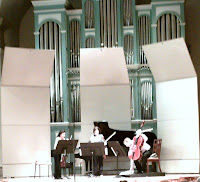

2. The program opened with Melinda and Ken playing Chopin's Introduction and Polonaise Brillante, a youthful (written at age 19) work that exudes love and joy. Tempos were brisk and exciting, with plenty of bravura for both.
3. Next was Hans Krasa's music, two short works written in a concentration camp just before Krasa's murder by the Nazi's. His music is well crafted and got a great performance from Okada and the Freudigmans (men? hahaha).
 4. Joaquin Turina's Scene Andalouse is a rare gem that should be heard much more often. Imagine a Debussyian texture with Spanish flavor with a gentle protaganist and you pretty much have it. Schotten was in the center leading in perfect style, and Lee provided lush and flashy color, along with the quartet of Stiles, Okada, and the Freudigmans.
 5. After intermission, a late string work by Brahms capped the program nicely, the String Quintet, opus 111. Ken sang with the intensity and passion required for the opening motif, and Schotten blended well with the San Antonians. There were smiles all around as each part cued here and there, allowing for phrases to play out with panache and ebb-and-flow easily. Especially tender was the slow movement allowing Stiles to shine in the upper register.
A pre-concert talk and reception added to the afternoon - you won't want to miss their next performance, October 19th featuring Tal Perkes, flute. Learn more here.
Monday, September 08, 2008
Five Things about Musical Evenings
I heard soprano Angela Malek with La Follia Sunday evening at San Fernando Cathedral as part of Musical Evenings with Musical Bridges Around the World.
 1. Things began before the concert, in front of San Fernando with period demonstrations of fencing, singing and dancing. There were also actors in costume, asking folks to come in for the concert.
2. The program featured just two composers, but what composers - Bach and Handel. There was a delightful mix of works, choral and instrumental.
 3. Soprano Angela Malek has a pure, clear voice well suited for this repertoire, and was ably backed by La Follia. Diction was clear and the costume she wore was delightful.
4. Bach's Trio Sonata #1 and Handel's b minor trio sonata are two of the great chamber music hits of all time. La Follia was muddy in the first movement of the Bach, but that was the only falter the entire evening. Otherwise, technique, pitch and phrasing were exquisite.
5. Explanations of the period instruments from the performers, with questions from the audience, filled what would have been intermission. It was a charming program indeed, and reached an audience that might not have normally caught early music - kudos!
These musicians are going to teach early music technique in San Antonio, keep an eye out for more performances and lessons...on tap is an authentic Brahms' German Requiem.
Musical Bridges Around the World will continue the free San Fernando concerts on the first Sunday of each month- be sure to check it out and to come early for the demonstrations beforehand.
 1. Things began before the concert, in front of San Fernando with period demonstrations of fencing, singing and dancing. There were also actors in costume, asking folks to come in for the concert.
2. The program featured just two composers, but what composers - Bach and Handel. There was a delightful mix of works, choral and instrumental.
 3. Soprano Angela Malek has a pure, clear voice well suited for this repertoire, and was ably backed by La Follia. Diction was clear and the costume she wore was delightful.
4. Bach's Trio Sonata #1 and Handel's b minor trio sonata are two of the great chamber music hits of all time. La Follia was muddy in the first movement of the Bach, but that was the only falter the entire evening. Otherwise, technique, pitch and phrasing were exquisite.
5. Explanations of the period instruments from the performers, with questions from the audience, filled what would have been intermission. It was a charming program indeed, and reached an audience that might not have normally caught early music - kudos!
These musicians are going to teach early music technique in San Antonio, keep an eye out for more performances and lessons...on tap is an authentic Brahms' German Requiem.
Musical Bridges Around the World will continue the free San Fernando concerts on the first Sunday of each month- be sure to check it out and to come early for the demonstrations beforehand.
Saturday, September 06, 2008
Five Things about Emmanuel Borok
 I heard the Musica Viva presentation of Musical Bridges Around the World of violinist Emmanuel Borok and pianist Anya Grokhovski-Michaelson.
1. The house of Susan and Aubra Franklin is gorgeous and set a wonderful background for the evening. Guests mingled beforehand and enjoyed the company, hors d'oeuvres, and house.
2. The program began with Kreisler's Variations on a theme by Corelli and was a perfect start. Balance was good and the tone singing.
 3. Mendelssohn's F Major Sonata continued the program and while it is a gem, it is not a masterpiece. Borok and Grokhovski-Michaelson were enthusiastic and brought life into this lesser known work.
4. "Bonbons" consisted of more Kreisler, Brahms, Massenet, Kroll, Gluck, and a Russian gem "The Happy Violin." They were chosen by the Franklin's youngest daughter from a stack of music. Things were light and quick, with good taste and brilliant technique.
5. Borok is an old school violinist -his playing reminds me of Mischa Elman. His is a classic and very laid back approach, and his vibrato is lightning quick. Grokhovski-Michaelson was a delightful collaborative pianist who worked well in the program.
 They play a similar program tomorrow afternoon at 3pm at McAllister Auditorium in San Antonio. Find out more here. Children under 13 are free! (and get to help pick the bonbons on the 2nd half of the program!)
Friday, September 05, 2008
Five Things about the Lee Trio
 I heard the Lee Trio at Ruth Taylor Hall at Trinity University tonight as part of the Redeemer Fine Arts Series.
1. The concert was beyond capacity, about the time the concert was supposed to start, they added chairs on stage to fit more audience. What a great thing!
2. The Bernstein piano trio is a youthful work that shows alot of promise - and in the hands of Melinda, Angela and Lisa Lee, very convincing. I heard lines I hadn't before, and was convinced I should listen again. Especially fun was the March, with playful pizzicati and charming harmonic bends.
3. Franz Joseph Haydn put his stamp on many genres - the symphony, string quartet and piano trio. This performance was a real delight, showing the humorous side and long melodic lines. Lisa was especially agile in fluid passages and Melinda brought the right flavor to the keyboard, with Angela providing a solid foundation. It was music making without effort and truly charming.
4. After intermission, Schumann's dark d minor trio finished the program - as the Lees said from on stage, it ends "with hope." The brooding first movement was unclear to my taste, but things came together for the flashy second movement. Ensemble was precise and crisp, nothing was left without care - each line getting the right umph. Lyricism prevailed in all parts for the slow movement, with especially beautiful singing from the strings. The finale came and flew by, tempi were always fresh.
 5. It was awesome to see people of all ages at the concert, but lots of young people (there must have been a third of the audience under 12 years old!) were enjoying it and were well behaved. If you have a chance to see the Lee Trio - do so, you won't be disappointed!
 The Reedemer Fine Arts Series continues in February with John Patitucci.
Thursday, April 10, 2008
Five Things about Gabriel Kahane
 I heard Gabriel Kahane at Joe’s Pub Wednesday night. If Billy Joel and Paul McCartney can write “classical music”, why can’t composers write “pop music”?
1. Gabe Kahane is a good singer, great pianist and out of this world showman. His wry and wonderful wit comes through his music and lyrics. Wednesday night Kahane shared his sounds with humor, humility and always in an entertaining way.
2. Ensemble with the four man band, including: piano, banjo, violin, clarinet, bass clarinet, drums, guitar, electric bass, toy piano and a melodic, was generally tight and toe tapping. Less stellar was the drummer playing banjo – it just didn’t click and wasn't heard very well – perhaps it was his trip from Seattle. Later when Kahane picked up the banjo, it was heard fine and in time!
3. Rob Moose played excellent lines whether it was on violin, guitar or bass. Also Sam Sadigursky shone in his bass clarinet lines, and as a toy pianist, rocked the joint.
4. New songs including Keen were charming, including a Pan-Am bag on the subway inspired song written that day – although the riffs were cool, the selections weren’t always memorable.
 5. The highlight of the evening was Kahane’s Craiglistlieder, a 21st Century masterpiece, both a virtuoso vehicle for Gabe singing and playing, and a biting commentary. Operatic riffs including pseudo recitative and rhythmic variety made this in a word, perfect.
The show was short but sweet – keep an eye out for the new album in August and go to http://www.gabrielkahane.com/to experience the Craiglistlieder for yourself, you’ll be glad you did!
Sunday, March 02, 2008
Five Things about Ten for Carter
 Network for New Music presented Ten for Carter Sunday afternoon in Philadelphia.
1. Composers were commissioned for piano works ni honor of Elliott Carter's upcoming 100th birthday in December 2008. They included Milton Babbitt, Uri Caine, Jeffery Cotton, Alvin Curran, Jennifer Higdon, Jeffrey Mumford, Augusta Read Thomas, Maurice Wright, Ellen Taaffe Zwilich and Jeremy Gill. Babbitt's was not completed and instead pianist Marilyn Nonken included Carter's Retrouvailles from 2000.
2. Most striking was Bells by Augusta Read Thomas, played by pianist Steven Gosling and inside the piano by Marilyn Nonken. The work was colorful and inventive, truly capturing the spirit of Carter.
3. Mumford's a celebration of Elliott was brilliant, with stellar and facile playing from Gosling.
4. Higdon's Mr. Carter's Notes and Zwilich's A Poem for Elliott were entertaining and fitting, with care and panache from Nonken's musical playing.
 5. Thomas Kraines was passionate in his reading of Carter's Figment #2, and was joined by other members of Network for Con Leggerezza Pensosa (from 1990 - the oldest work on the program!) and played it not once, but twice, before intermission and at the end of the program.
Afterwards, a reception followed with a q&a with the pianists and composers. The concert was also played Friday night in NYC. Hear an interview with Jeremy Gill here about his Eliot Fragments.
Friday, January 18, 2008
Five Things about The Singing Rooms
I heard the second concert of week two for the Bernstein Festival with the Philadelphia Orchestra last night.
1. The concert began with a spirited reading of Bernstein's Symphony #1. Whenever I hear this work, I ask myself why I don't hear it more often. It is the excellent work of a young musician and a look at the potential of this great composer. Rinat Shaham was stunning, in her performance and in her passion! She couldn't keep still in her chair in front of the orchestra, swaying to the music and rhythm. When she finally did sing, it was exquisite.
2. Jennifer Higdon's The Singing Rooms followed. I died there in Verizon Hall, because Higdon's music and Jennifer Koh's playing were heavenly. The combination of solo violin, orchestra and chorus was perfectly set, with sections allowing each to shine, and to combine for the greatest music I have ever heard.
3. The Singing Rooms consists of seven movements played attaca (back to back without pause) and while they are seemless, they depict the action of walking around a house, starting in the morning, with singing going on in the rooms, and returning back to that first room at the end of the day. Higdon treats the lush poetry by Jeanne Minahan well, and the singing from the Philadelphia Singers Chorale was well done.
4. Jennifer Koh is my hero. She commissioned this work, and also Higdon's String Poetic (a work I am performing a movement this March for Composing Thoughts Live) and I've heard a solo violin work may be in the works for Koh by Higdon as well, making a Higdon violin trilogy (maybe it could be titled TRILLOGY? hahaha) for Koh. This is historic, like the collaboration between Joachim and Brahms, or Stravinsky and Dushkin. I'm so happy to have heard this first performance.
5. The variation and innovation of Higdon's work is tremendous, especially considering a week before, Concerto 4-3 was premiered, and that another Violin Concerto is being written for another former Curtis student, Hilary Hahn.
As for the Singing Rooms, rhythm, orchestration and musical taste were at highpoints. Never was there a moment that you weren't engaged, although there were two tiny moments where you had problems hearing the soloist with all the forces playing.
Performances of Hai-Ye Ni, principal cellist; and concertmasters David Kim and Juliette Kang accented lyric and virtuosic lines of Koh's solo parts. An extended section with Ni was out of this world.
I can't recommend highly enough that you go hear this work, and if you are anyone involved with programming orchestra repertoire, to put this work on your programs. The curtain calls had the audience wanting more!
Read my friend and coworker Dick Strawser's eloquent account of this premiere here.
Hear an interview with Jennifer Higdon here about this work, and learn about a chance to meet Higdon and learn more about her music here.
1. The concert began with a spirited reading of Bernstein's Symphony #1. Whenever I hear this work, I ask myself why I don't hear it more often. It is the excellent work of a young musician and a look at the potential of this great composer. Rinat Shaham was stunning, in her performance and in her passion! She couldn't keep still in her chair in front of the orchestra, swaying to the music and rhythm. When she finally did sing, it was exquisite.
2. Jennifer Higdon's The Singing Rooms followed. I died there in Verizon Hall, because Higdon's music and Jennifer Koh's playing were heavenly. The combination of solo violin, orchestra and chorus was perfectly set, with sections allowing each to shine, and to combine for the greatest music I have ever heard.
3. The Singing Rooms consists of seven movements played attaca (back to back without pause) and while they are seemless, they depict the action of walking around a house, starting in the morning, with singing going on in the rooms, and returning back to that first room at the end of the day. Higdon treats the lush poetry by Jeanne Minahan well, and the singing from the Philadelphia Singers Chorale was well done.
4. Jennifer Koh is my hero. She commissioned this work, and also Higdon's String Poetic (a work I am performing a movement this March for Composing Thoughts Live) and I've heard a solo violin work may be in the works for Koh by Higdon as well, making a Higdon violin trilogy (maybe it could be titled TRILLOGY? hahaha) for Koh. This is historic, like the collaboration between Joachim and Brahms, or Stravinsky and Dushkin. I'm so happy to have heard this first performance.
5. The variation and innovation of Higdon's work is tremendous, especially considering a week before, Concerto 4-3 was premiered, and that another Violin Concerto is being written for another former Curtis student, Hilary Hahn.
As for the Singing Rooms, rhythm, orchestration and musical taste were at highpoints. Never was there a moment that you weren't engaged, although there were two tiny moments where you had problems hearing the soloist with all the forces playing.
Performances of Hai-Ye Ni, principal cellist; and concertmasters David Kim and Juliette Kang accented lyric and virtuosic lines of Koh's solo parts. An extended section with Ni was out of this world.
I can't recommend highly enough that you go hear this work, and if you are anyone involved with programming orchestra repertoire, to put this work on your programs. The curtain calls had the audience wanting more!
Read my friend and coworker Dick Strawser's eloquent account of this premiere here.
Hear an interview with Jennifer Higdon here about this work, and learn about a chance to meet Higdon and learn more about her music here.
Thursday, January 10, 2008
Five Things about Concerto 4 3
 I heard the world premiere of Jennifer Higdon's Concerto 4 3 Thursday night in Philadelphia. Part of the Bernstein Festival continuing through February 2nd.
1. I was interviewing Jennifer during the first half (watch this space for updates and a posting of it!) so I only heard the first half of Tchaikovsky and Bernstein via speakers, and left after the concerto because I had worked that morning and had to go to work the next day as well. But the program was well varied and it didn't seem that anyone left the second half, which had the world premiere with Time For Three and Tchaikovsky's Francesca da Rimini. Bassist Ranaan Meyer introduced the work briefly, giving the background of how the work came into being.
[The picture above left is at intermission, when we came into the hall - Jennifer was recognized by patrons, students and audience members, but we snapped this quick picture.]
2. The first movement of Concerto 4 3 is short, sweet and busy. It features the Trio prominently, with lots of extended blugrass techniques. Zachary DePue was stellar with his bow scraping in the right hand and bold leaps with his left. I was a little surprised that they didn't have stands or music, the trio played it from memory with flair, panache and let you know they were having fun. Maestro Eschenbach also seemed to be watching them alot and smiling.
3. The central slow movement is the longer of the concerto and certainly lets the orchestra blend with the trio, especially haunting and beautiful is a section with the oboes who melt your heart. Lines come and go, from the trio to the orchestra and back. The whole movement was seemless with the first and featured the trio in a cadenza that blew your mind. Meyer's bass was stunning in melodies, although often his movement seemed over the top.
4. The finale is wonderous and toe tapping. Again, Higdon's brilliant orchestration shines and allowed Time for Three to jam, where percussion leads to brass to the winds and strings, all while the soloists play the perfect mix of classical and bluegrass. Nick Kendall fiddled and swayed with timing just right with his comrades, often melding in unison lines.
 5. The audience was on its feet, and shouts of "Bravo" echoed in the hall - you probably heard me whistle and hoot. While I thought perhaps "The Singing Rooms" will make the history books for its unique orchestration of Violin, Chorus and Orchetsra, I think Concerto 4 3 will long be remembered for its groundbreaking freedom of styles. I've never experienced such quality of music in varied styles, and with such tasteful, miraculous execution. Simply a masterpiece.
Stay tuned for a review of "The Singing Rooms" this next week and an interview to be posted at Composing Thoughts!
Read my previous posting about more of Jennifer's concerts here. Learn about her upcoming Composing Thoughts Live here.
Thursday, November 08, 2007
Five Things About the Dubrovnik Symphony
I heard the Harrisburg performance of the Dubrovnik Symphony's US tour Wednesday night at the Whitaker Center.
 1. The program opened with Pero Šiša's Konvale Svita (Konavoska Suite), written for the DSO. Its a charming overture, a single movement of impressions from the area in Croatia where Pero grew up. It is masterfully orchestrated.
 4. The group brought one more work for an encore, Mozart's Overture to the Marriage of Figaro. Again, it was a perfect upbeat, crisp interpretation, and I heard new colors I hadn't before in this score - kudos to the winds!
 Best wishes and safe travel for the group as they go to New York Thursday and back home to Croatia. Let's hope its not another 30 years before they come back!
 1. The program opened with Pero Šiša's Konvale Svita (Konavoska Suite), written for the DSO. Its a charming overture, a single movement of impressions from the area in Croatia where Pero grew up. It is masterfully orchestrated.
2. Boris Papandopulo's Xylophone Concerto was next, featuring  Jan Lotko and the strings of the DSO. It is exciting and brilliant! Again, tailor made for this soloist and orchestra, the work was well balanced and filled with skill and wit, from both the composer and the soloist. The waltz movement allowed concertmaster Elvira Galioulline to shine as well.
 Jan Lotko and the strings of the DSO. It is exciting and brilliant! Again, tailor made for this soloist and orchestra, the work was well balanced and filled with skill and wit, from both the composer and the soloist. The waltz movement allowed concertmaster Elvira Galioulline to shine as well.
3. The second half was Mozart's final Symphony, Number 41 "Jupiter." Tempos were crisp and  clean - outstanding ensemble and pitch throughout this classical era masterpiece. Especially touching was the second movement, with a very poetic and stirring interpretation from Maestro Zlatan Srzic.
 clean - outstanding ensemble and pitch throughout this classical era masterpiece. Especially touching was the second movement, with a very poetic and stirring interpretation from Maestro Zlatan Srzic.
 4. The group brought one more work for an encore, Mozart's Overture to the Marriage of Figaro. Again, it was a perfect upbeat, crisp interpretation, and I heard new colors I hadn't before in this score - kudos to the winds!
5. It was a real treat to hear this group, and I'll be adding Dubrovnik to my destinations in Europe to visit after hearing and meeting these charming musicians. The only black mark on this concert was the horrendous lighting the Whitaker Center provided. I was embarassed as a Harrisburg resident that a more professional presentation of this splendid group couldn't have allowed them to clearly see the soloist, musicians on the fringe and front of the stage!
 Best wishes and safe travel for the group as they go to New York Thursday and back home to Croatia. Let's hope its not another 30 years before they come back!
Thursday, October 25, 2007
Five Things about Kiri Te Kanawa
 I heard the "Farewell Recital" of Kiri Te Kanawa at the Kimmel Center Wednesday night in Philadelphia.
1. The crowd was pretty boring and not very excited at the outset - a medium house couldn't be blamed on the rain - it was too bad because what followed for the night was exquisite. After intermission the energy was higher in the crowd. Everyone also applauded after every song, even when it was only a few minutes long - so while that wouldn't normally bother me - it was musically interuptive in the song sets. Dame Kiri would smile occassionally and nod, but all too often someone had to clap over the sublime sounds of Warren Jones at the keyboard. While their love for Kiri's artistry was great, there wasn't much respect for the music.
 2. Having Kiri sing a set of Richard Strauss songs, including some of my favorites: Die Nacht and Morgen, was heavenly. One felt she was singing to just you, despite being in a large concert hall.
3. If something better could follow Strauss, it was the nasally and sumptous Duparc songs, with breathy and irresistible singing. Again, Warren Jones outdid himself as a collaborative pianist.
 4. The second half was filled with more energy, and showed a lighter side to Dame Kiri, from her speaking about Jake Heggie and the everyday man (common if you will) humor of Copland's "Why do they shut me out of Heaven?". Several times Kiri checked notes or words placed slyly on the piano lid - who cares, it was magnificent!
5. The encores, Ginastera's "Song of the Olive Tree" was vibrant and sexy; Richard Rodney Bennett's "Goodbye For Now" was charming and sweet. You wanted more and knew unlike some artists who have performed well past their prime, that Dame Kiri is finishing at the top of her game - we'll look forward to her teaching and more intimate performances.
 Catch Dame Kiri on this tour if you can, and while you're at it, buy her Traviata or Capriccio or Four Last Songs - you'll be glad you did.
Also see this post about Kiri, tea and me.
Friday, October 12, 2007
Five Things about the Cypress Quartet
 I went to Annville to hear the Cypress String Quartet at Lebanon Valley College last night.
1. The quartet played almost immediately after taking the stage, there was no tuning, retuning and rigamaroll of technical adjustments - it was all about the music with the Cypress.
2. The program began with Mozart's Quartet K 575, complete with tasteful tempi and amazing balances. Melodic lines were supported with the greatest of care and with the right amount of flippant fun. It's the way Mozart should be played.
3. Samuel Barber was next and his only String Quartet - yes - the origin of his famous Adagio. Violinist Tom Stone spoke briefly before the quartet, talking about Barber and this music. What followed was fresh music making and some of the most idosyncratic stylistic playing that made Barber more Barber than he might have ever imagined. It was clear, gorgeous and in a word, sumptuous. I heard talk afterwards that audience members wanted more time between the 2nd and final movement, which I imagine if it wasn't marked attacca by Barber himself, was a choice the Cypresses made to keep from early applause. In any case the transition Barber makes between the Adagio and last movement is spot on, not needing any space in my opinion.
 4. After intermission, the quartet played Dvorak's charming G major Quartet, Opus 106. It's a late work and you certainly get the idea that Dvorak had already mastered this form. In the hands of the Cypress Quartet, the ideas flowed spaciously and with ease. Again, balances and contrasts were handled with grace and charm. It was appreciated by the full hall with a standing ovation. Unfortunately a student photographer was clicking pictures during the first three movements, adding unpleasant percussion to those around her.
5. The night ended with an encore with Josef Suk's Barcarolle. The quiet lyrical piece served as a musical dessert following the main course of the concert, and the audience went home full and pleased.
 It was such a delightful evening and the Quartet's programs are always interesting, check their schedule out here! This program isn't demonstrative of their commitment to new music, which you should purchase their Jennifer Higdon recording on Naxos, or cds of Jeffery Cotton or Schulhoff.
Monday, February 19, 2007
A response to a response
More from Comparing Notes at Minnesota Public Radio. Here's what I had to say:
John-
Thanks for your response, and congrats on a successful drive!
A few more points, to help clarify (or clare-ify if you will, hahaha)
If John had read carefully, I wrote "perhaps" they walk out because the music is bad.
Great word, "perhaps"...and I agree completely. Most of this discussion comes from my part reading it before coffee and a cigar. I’m now trying to take time in making these comments precise and with thought (hence sleeping on it last night and posting today.)
I just don't see that many folks walking out on concerts in general - nor do I really want them to leave unless they do give it a chance (be it Beethoven or Babbitt!) – what is “giving it a try” length?
Quantity ain't necessarily quality.
I'm asserting that the many concerts I take in there IS great quality to the performance and music choices. Of course, I spend a large amount of time figuring out what concerts to go to before I go - which I recommend to others as well.
I am not asserting that since there are so many composers these days that music is on a higher level - but in general I want to make a point that American music really is top form – hence the Vienna of the 1890s comparison. You should really give music every bit of chance. Perhaps this is why I don’t watch American Idol: I want to make my own opinion, and I also do not want to judge immediately.
This assumes that a) you gave it a fair shake, and b) it's not disruptive to others at the concert who *are* getting the experience they came for.
Amen! and there (being disruptive) is where I have a huge problem: talking during the music or being loud in leaving. Please, if you must leave, be kind and respectful to the other audience members.
If it was simply a matter of being averse to "sonic disturbances," people would be leaving movie theaters in droves every night of the week at Dolby THX suburban multiplexes across the land.
THIS is where I mentioned the latest movies. Sorry, but I didn’t get the idea you were talking about volume, rather I took it as content.
if the art that's presented to them has a compelling story to tell, one that makes them so engaged that they can't wait for the next scene, the next movement, the next chapter.
I will maintain that if you go through a journey, things become clearer. Should people leave after the first chord in Beethoven’s Ninth Symphony finale?! Gosh, if you don’t like percussion, shouldn’t I leave Beethoven’s Ninth when the second movement starts with that awful timpani?! If you stay through an entire piece, you’ll get the architecture and perhaps some catharsis…I will say if the orchestra is butchering a work, say a masterpiece like Beethoven’s Ninth, you should feel free to leave. (But again, please be considerate to other concert goers!) [A cinematic comparison could be made with the movie “Crash” – where after the first hour things are connected that weren’t before; if you left the theater after that hour, you would have a very different view of this movie than staying for the entire film. A literary example might be an Ayn Rand novel where five seemingly unrelated elements are all drawn together to make a compelling and remarkable story. Yet, if you stop reading it, you don’t realize the elements are there to clarify it.]
Mostly I yearn to keep an open mind about art – especially music of our time. I do not want to give any ammunition for the bashing of new music. It’s close to my heart and I try to protect it in any way possible.
John, I will admit there are compositions I don’t care for, but you’ll hear me plead for those that I love, rather than those I hate. (Hard to believe after my passionate defense above, huh?) I write a regular “Five Things” post on ClassicallyHip about concerts I attend. They are on the whole positive, because I write about what I liked, rarely about the negative.
So, I’ll come around and answer, What keeps me in my seat?
Creativity, originality, beauty, and curiosity.
More specifically, performers like Helene Grimaud, Janine Jansen, eighth blackbird, and Gil Shaham. Composers like Andrzej Panufnik, Jennifer Higdon, Augusta Read Thomas, Elliott Carter, and John Harbison to name a few.
I hope more folks comment on what keeps them in their seat, I’m anxious to know!
John-
Thanks for your response, and congrats on a successful drive!
A few more points, to help clarify (or clare-ify if you will, hahaha)
If John had read carefully, I wrote "perhaps" they walk out because the music is bad.
Great word, "perhaps"...and I agree completely. Most of this discussion comes from my part reading it before coffee and a cigar. I’m now trying to take time in making these comments precise and with thought (hence sleeping on it last night and posting today.)
I just don't see that many folks walking out on concerts in general - nor do I really want them to leave unless they do give it a chance (be it Beethoven or Babbitt!) – what is “giving it a try” length?
Quantity ain't necessarily quality.
I'm asserting that the many concerts I take in there IS great quality to the performance and music choices. Of course, I spend a large amount of time figuring out what concerts to go to before I go - which I recommend to others as well.
I am not asserting that since there are so many composers these days that music is on a higher level - but in general I want to make a point that American music really is top form – hence the Vienna of the 1890s comparison. You should really give music every bit of chance. Perhaps this is why I don’t watch American Idol: I want to make my own opinion, and I also do not want to judge immediately.
This assumes that a) you gave it a fair shake, and b) it's not disruptive to others at the concert who *are* getting the experience they came for.
Amen! and there (being disruptive) is where I have a huge problem: talking during the music or being loud in leaving. Please, if you must leave, be kind and respectful to the other audience members.
If it was simply a matter of being averse to "sonic disturbances," people would be leaving movie theaters in droves every night of the week at Dolby THX suburban multiplexes across the land.
THIS is where I mentioned the latest movies. Sorry, but I didn’t get the idea you were talking about volume, rather I took it as content.
if the art that's presented to them has a compelling story to tell, one that makes them so engaged that they can't wait for the next scene, the next movement, the next chapter.
I will maintain that if you go through a journey, things become clearer. Should people leave after the first chord in Beethoven’s Ninth Symphony finale?! Gosh, if you don’t like percussion, shouldn’t I leave Beethoven’s Ninth when the second movement starts with that awful timpani?! If you stay through an entire piece, you’ll get the architecture and perhaps some catharsis…I will say if the orchestra is butchering a work, say a masterpiece like Beethoven’s Ninth, you should feel free to leave. (But again, please be considerate to other concert goers!) [A cinematic comparison could be made with the movie “Crash” – where after the first hour things are connected that weren’t before; if you left the theater after that hour, you would have a very different view of this movie than staying for the entire film. A literary example might be an Ayn Rand novel where five seemingly unrelated elements are all drawn together to make a compelling and remarkable story. Yet, if you stop reading it, you don’t realize the elements are there to clarify it.]
Mostly I yearn to keep an open mind about art – especially music of our time. I do not want to give any ammunition for the bashing of new music. It’s close to my heart and I try to protect it in any way possible.
John, I will admit there are compositions I don’t care for, but you’ll hear me plead for those that I love, rather than those I hate. (Hard to believe after my passionate defense above, huh?) I write a regular “Five Things” post on ClassicallyHip about concerts I attend. They are on the whole positive, because I write about what I liked, rarely about the negative.
So, I’ll come around and answer, What keeps me in my seat?
Creativity, originality, beauty, and curiosity.
More specifically, performers like Helene Grimaud, Janine Jansen, eighth blackbird, and Gil Shaham. Composers like Andrzej Panufnik, Jennifer Higdon, Augusta Read Thomas, Elliott Carter, and John Harbison to name a few.
I hope more folks comment on what keeps them in their seat, I’m anxious to know!
Subscribe to:
Posts (Atom)

