Showing posts with label review. Show all posts

Monday, November 02, 2015

One for the ages

Heggie and Clare
I heard Great Scott Sunday afternoon at Dallas Opera. Throughout the opera, I kept thinking, this is an aria that I'm going to hear in recital, that singers are going to take up (much like one hears Nessun Dorma or O Mio Babbino Caro from Turnadot or Gianni Schicchi) - but it wasn't just one tune, it was almost all of them! That's not a big surprise from a composer like Jake Heggie.
Great Scott is personal, and affable. The comedy has drama, and flair. Not only does this come from the original libretto by Terrance McNally, but from the music, and the stellar cast. It is also funny and witty. Stereotypes abound throughout the two acts, from the two male leads as bari-hunk and narcissistic tenor, to an overeager, young understudy who "would kill" to make it. There's also love: a star and her mentor, a conductor and stage manager, an old flame and the one that got away, as well as the heartstring pulling demonstration for the love of music/opera.
Joyce DiDonato goes beyond the role of Arden Scott. She is Great Scott. Here's a star that returned to her home town Symphony garnering national attention, and then a few years later sang at Game Seven of the World Series with her hometown team...and the singing? The role requires the juxtaposition of modern and Bel Canto opera singing - just two of her signature traits - seamlessly throughout the opera.
I mentioned Puccini as examples earlier, but the only real comparison I can make of Great Scott is with Richard Strauss. The opera within an opera, Rosa Dolorosa, Figlia di Pompeia isn't the first fictional work complete with a Composer role, that would be Ariadne auf Naxos. Here though, Heggie and McNally make use of a rehearsal, and then a performance of Rosa in the second act, to great use in both the story line and for DiDonato's impeccable singing. A final quartet also mirrors (in the best sense) the famous Trio in Der Rosenkavalier.
There is so much to love about Great Scott, and this performance was outstanding. It could be called a "perfect storm" of talent and accomplishment of the part of all. Go see it in Dallas now, or put it on your calendar for May in San Diego!
Hear an interview with John and Jake here: http://www.kmfa.org/pages/807-texas-grand-opera-composer-jake-heggie

Saturday, July 14, 2012

Orchestra on the rise

There's a great saying about the sum being more than its parts - which isn't necessarily true for all orchestras, but add the new Artist Director Alondra de la Parra to the Orquesta Filarmonica de Jalisco and not only do things multiply exponentially, they electrify!
I heard the Programa 6 on Friday, July 13 in the beautiful Teatro Degollado. Silvestre Revueltas' Sensemaya opened the all orchestra program. This work can be terrifying and hypontic, and the OFJ was up to the task. It's colorful and inventive, I don't know why it doesn't appear on more programs than it does...kudos to Tomas Rosaleny who nailed the tuba solo and the excellent work of the percussion section which was crisp.
Tchaikovsky's Sleeping Beauty was next on the sold out program (yes, three days before the show, you could not find tickets!) There may not be anything more beautiful than de la Parra on the podium - it is quite poetic that this young leader gives her orchestra just what they need in terms of rhythm, and at the very same time, gives the audience a breathtaking show. For Tchaikovsky's five movement suite, it ran the gamut of toe tapping waltzes to introspective scenes, best heard in the popular Valse of Act I.
Alondra de la Parra in Shostakovich

After a short intermission, the program finished with Dmitri Shostakovich's Fifth Symphony - one of the all time dramatic and wellcrafted orchestra works, playing with two notes, "bah bum" and the reverse "bum bah" through all four movements. Perhaps Friday the 13th struck some in this performance, with a complete left field solo from the principal horn that was clearly off (which had not improved from the open rehearsal in the morning, sad.) and a flying baton from de la Parra that landed in the violas (I've seen that happen lots to conductors, but never have I seen them have a backup baton - she did, and continued without a blink!) Other than that, Shostakovich would have rejoiced in brisk tempos, fiery lines and geniune excitement of this performance. Especially touching were solos from concertmaster Bryan Lee, harpist Guadalupe Perez, and the keyboardist playing piano and celesta (not named in the program, but she was spot on!) There was also delightful, bone chilling percussion work from the xylophone (so many great repeated notes right along with the violins and flutes) as well as the stunning finale with timpani and bass drum in perfect sync with de la Parra (in rehearsal it was equally exciting to see this be put together!)
The audience was on its feet and after solo bows, de la Parra was presented flowers and as orchestras can do, refused to stand when Alondra motioned, allowing their Artistic Director warm applause from the audience and them.
I cannot express enough how delightful this concert was, and what music making was shared. World class hall, check. Out of this world conductor, check. Orchestra willing to work, check. Excited audience, check. This is the recipe for great entertainment and success for the OFJ and Guadalajara.
Bravissimo!
This program repeats Sunday afternoon at 12:30, and was reported sold out, but I would check at the box office for any cancellations, and be sure to get season tickets for the next concerts at http://www.ofj.com.mx/

Lea esta revisión en español: http://classicallyhip.blogspot.com/2012/07/orquesta-en-ascenso.html

Saturday, January 24, 2009

Five Things about the Houston Symphony

I heard the Houston Symphony again tonight in Jones Hall. (Read about the premiere performance Thursday night, here at Sequenza21.)

1. Augusta Read Thomas spoke before the concert (see a video clip here) - showing some of the hand written score. There were lots of questions from the audience and good background about the work and Thomas' approach to composition.

2. Absolute Ocean's first movement is poetic and pointilistic. I heard strains of Copland in the music tonight, a flavor I didn't notice Thursday. There was a complete gaff in the supertitles - which I ignored even when they returned in the second movement - choosing to focus completely on the performance and music. Soprano Twyla Robinson' diction is such that you don't need the supertitles - and her voice is pure, passionate and pleasing.

3. The second movement, complete genius, was quicker and flowed with all of its humor, charm and brilliance. Ensemble was tight with the soloists and orchestra.

4. After a brief cadenza, the finale movement is touching and appropriately dramatic. Word painting without being banal certainly highlights the poetry with sublime music.

5. Mahler's Fourth Symphony is an ideal pairing for Absolute Ocean, and in particular, Twyla Robinson - she's busy for the first 20 minutes of Thomas' piece, then has a break until the finale of Mahler...also the dreamy score of Thomas leads beautifully to the heavenly view of Mahler. A completely satisfying program.

There is another performance of Absolute Ocean and Mahler's Fourth Symphony tomorrow afternoon at 2:30pm.

Friday, October 17, 2008

That's my bit

Hey, they're taking my "Five Things!" Of course, I only picked Five Things (almost always positive!) to give myself a framework to write about concerts...and I never claimed it was an original concept for concert criticism or blogging...

Monday, April 02, 2007

Five Things about Alarm Will Sound

I heard the "farewell" concert at Dickinson College of the ensemble in residence, Alarm Will Sound (AWS) Saturday night at Rubendall Hall.
1. The evening was stellar, from precise and moving performances to educational activities where the students were playing alongside the performers (in a new work nonetheless!) to a killer reception afterwards.
2. Michael Gordon has a far better sense of rhythm than I do. So does Benedict Mason. In fact, AWS does in general! Some great funky stuff - catch them when they come to your town - and buy their cds.
3. The premieres the whole evening were superb, and the program itself was so well crafted. I enjoyed "Plays Well With Others" by Robert Pound - who led his work with panache and sparkle.
4. John Orfe's Chamber Symphony was particularly good, and his knowledge of his colleagues shows in the writing (he's the pianist in AWS). Of course, his company and friendship with Ezra Ladermann and John Adams doesn't hurt I'm sure. The work has a Mahlerian feel with 21st century good taste - that is to say, it is a serious and virtuosic work which I long to hear again.
5. The encore was from their Aphex Twin cd, conceived at Rubendall Hall a few years ago. It was delightful, but I would have also had them encore even more - I almost shouted "Da Capo!" at the end of Animals and the Origins of Dance. (The musicians all leave the stage, where pre-recorded sounds are heard along with off stage playing! pictured left.)

I'm looking forward to hearing AWS again live and on future cds!
[You can hear and see interviews with Robert Pound and John Orfe here.]
BTW, my friends joined me: Zach, Bob and Sue - we had great seats!
I also had the great pleasure to finally meet Mel and Matt:
Read Melissa's blog here. Turns out she knew a player from high school and I knew the cellist who was subbing previously...small world!

Monday, March 19, 2007

Five Things about Chris Thile

I caught the second of "In Your Ear Redux" concerts at Zankel Hall with The Tensions Mountain Boys Saturday night, and I was happy I did!
1. Chris Thile (mandolin, voice and composer) is clearly a masterful musician. His new group The Tensions Mountain Boys (Chris Eldridge, guitar/vocals; Greg Garrison, Bass; Noam Pikelny, Banjo; Gabe Witcher, violin (nee fiddle)/vocals; and Thile) is a perfect match. They all connect with astounding playing abilities and a certain nonchalance on stage. Thile was downright comedic in his delivery: "You're all so kind to come here tonight, but why are you in your underwear? We dressed up!" and as the lighting changed for the evening's featured work, "Yeah, Blue! - uhm, of course, it's Bluegrass!"
2. The concert started with a few short selections before The Blind Leaving the Blind. It allowed the group to warm up, check things and was a delightful introduction. Thile has a "voice sweetly bland" and performs with a certain integrity and distinction.
3. The main work (really why I was at the concert in the first place) was The Blind Leaving the Blind. Terry Teachout* in his notes describes it as a "40 minute suite" and perhaps as a "cantata." Thile announced that there would be three definite stops, with tuning in between and that it might be considered in six sections.
It is a beautiful journey, with sometimes angular melodies (such as the second movement) and for me, the emotional pinnacle was the lengthy third movement. The finale is aptly virtuosic, but not as engaging as the middle movements.
I don't think this will translate well for others, the way Bach does or even the way Glass or Reich does in the hands of say Alarm Will Sound, but it is great music. I just believe this ensemble fits like a glove to the music and would not fit others - but I'm happy to be wrong on this point.
Suffice it to say, The Blind Leaving the Blind isn't a typical bluegrass jam or a stuffy cantata, rather a blend of genres and talents that only a virtuoso like Thile & company could pull off.
(*Small aside, I think Teachout was sitting just a row ahead of me at the concert - and John Adams was on the right side boxes - I even spied Dawn Upshaw as I was upstairs before the concert)
4. The concert had a certain flow and good feeling. The group jammed to a point of ebullience, and certainly communicated both musically and verbally this joy in performing. The audience was certainly into the groove as well, I don't know that I've felt such a vibe in a long time.
5. Thile announced that The Tensions Mountain Boys was the new group and they would continue on after tonight. They also came back and did encores for the ecstatic crowd, including a very fun blues tune which started completely a capella for all five. Even after this, the audience wanted more, but the house lights finally faded up with the realization that the magical night had come to a close.
[photos used by permission by Jennifer Taylor]

Wednesday, January 31, 2007

Five Things about the St Lawrence String Quartet

I caught the Penn State performance of the St. Lawrence String Quartet (pictured below left) with soprano Heidi Grant Murphy (seen right) and pianist Kevin Murphy (below right) last night in State College.

1. The program was re-arranged, and as violinist Geoff Nuttall explained on the second half - despite their manager's insistance - that "the best was saved for last", even though it was the "modern piece." Nuttall said his dad used to complain in Canada that he'd go to concerts and have to sit through the modern piece before he could get to the romantic stuff.
In this case, it was the world premiere of Roberto Sierra's Songs of the Diaspora (Sierra pictured very bottom left). Geoff also joked (with the help of an usher?) that the doors were barred, and a clunk was heard! No one left after the announcement either.
So the line up was Chausson, Shostakovich, intermission, Debussy and Sierra. (Originally and printed in the program were the Shostakovich, Chausson, Sierra, Debussy.)

2. Ernest Chausson’s Chanson Perpétuelle, or Song without End, was a delightful way to begin the program, and in the capable hands of Heidi Grant Murphy, Kevin Murphy and the St. Lawrence Quartet (hereafter referred as SLSQ), you really didn't want the song to end. Especially charming was the ease of Murphy's voice changing from silky smooth melodic lines to nasal French inflections.
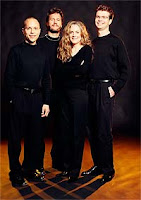
3. The SLSQ were like cartoon caricatures, in the best possible sense. In a way, they reminded me of the Guarneri Quartet circa 1980s: a virtuosic, flashy First Violinist, and steady and reliable Second Violinist, and mellow yet astounding Violist, and a energetic and well grounded Cellist.
Really the lineup for the SLSQ is just right, they ineract superbly and with the same musical and physical motion. Their Shostakovich Third Quartet, out on EMI Classics with the 7th and 8th Quartets, is dead on. And live, it was superb.

4. After intermission, I was thoughly disappointed by the Debussy performance. It wasn't that the flippant and carefree reading wasn't without excitement or depth. At times, it was breathtaking and gorgeous, but too many times the tempos were overdone, ridiculously slow and predictable accelerations - which could have been effective if it were annoying and for no apparent musical reason. There were also some humorous missed notes, such as glissandi that never made it to the actual note. I should say it was all done in the SLSQ character and with a good unison ensemble approach. It just wasn't enjoyable for myself. Ol' Claude might have done a little spinning himself in the grave along with me in my seat.

5. Roberto Sierra's Songs of the Diaspora was the reason I was at this concert, and I wasn't disappointed. Again, Murphy & Murphy joined the SLSQ for perhaps what was the biggest workout of the night. Sure, there were some ensemble issues (Scott St. John taking the 1st Violinist spot wasn't together with Violist Lesley Robertson on the opening Ocean/Klezmerish run - although when it returned, they were spot on) but overall it was a dynamic and interesting piece. The mostly lyric and traditional songs are of a moderate tempo and let each member make some music - lots of harmonics, pizzicati and wonderful interaction for the quartet and piano.
Of the seven, two are at a faster tempo: the fourth, "My mother-in-law, the evil one" and the final "The siren" are engaging and dramatic. They help shape the cycle from the idyllic trance Sierra weaves. Besides the rhythmic uniformity, I thought there might have been more ensemble variety, but then again, if you're writing for a piano quintet and soprano, why NOT have them busy all the time?
While the director of the arts center mentioned to be quiet while following the texts (they had an insert of all the songs with translations) the performers still had to wait for all of the noise to stop as the audience turned pages quite loudly (at least it wasn't typically during the music, but between movements!)
All-in-all, the Songs are well crafted and suit the strengths of the ensemble in an imaginative way.

The Songs of the Diaspora will be played across the country by these artists, catch it if you can!

Afterthought, or Post-Script: I hate mentioning what the performer wore, but yes, Heidi made a wardrobe change (no manfunctions, hahaha) - from a gorgeous springlike ensemble for the Chausson to a elegant black outfit for the Sierra.
You can read another account of this evening here.