More from
Comparing Notes at
Minnesota Public Radio. Here's what I had to say:
John-
Thanks for your response, and congrats on a successful drive!
A few more points, to help clarify (or clare-ify if you will, hahaha)
If John had read carefully, I wrote "perhaps" they walk out because the music is bad.
Great word, "perhaps"...and I agree completely. Most of this discussion comes from my part reading it before coffee and a cigar. I’m now trying to take time in making these comments precise and with thought (hence sleeping on it last night and posting today.)
I just don't see that many folks walking out on concerts in general - nor do I really want them to leave unless they do give it a chance (be it Beethoven or Babbitt!) – what is “giving it a try” length?
Quantity ain't necessarily quality.I'm asserting that the many concerts I take in there IS great quality to the performance and music choices. Of course, I spend a large amount of time figuring out what concerts to go to before I go - which I recommend to others as well.
I am not asserting that since there are so many composers these days that music is on a higher level - but in general I want to make a point that American music really is top form – hence the Vienna of the 1890s comparison. You should really give music every bit of chance. Perhaps this is why I don’t watch American Idol: I want to make my own opinion, and I also do not want to judge immediately.
This assumes that a) you gave it a fair shake, and b) it's not disruptive to others at the concert who *are* getting the experience they came for.
Amen! and there (being disruptive) is where I have a huge problem: talking during the music or being loud in leaving. Please, if you must leave, be kind and respectful to the other audience members.
If it was simply a matter of being averse to "sonic disturbances," people would be leaving movie theaters in droves every night of the week at Dolby THX suburban multiplexes across the land.
THIS is where I mentioned the latest movies. Sorry, but I didn’t get the idea you were talking about volume, rather I took it as content.
if the art that's presented to them has a compelling story to tell, one that makes them so engaged that they can't wait for the next scene, the next movement, the next chapter.I will maintain that if you go through a journey, things become clearer. Should people leave after the first chord in Beethoven’s Ninth Symphony finale?! Gosh, if you don’t like percussion, shouldn’t I leave Beethoven’s Ninth when the second movement starts with that awful timpani?! If you stay through an entire piece, you’ll get the architecture and perhaps some catharsis…I will say if the orchestra is butchering a work, say a masterpiece like Beethoven’s Ninth, you should feel free to leave. (But again, please be considerate to other concert goers!) [A cinematic comparison could be made with the movie “Crash” – where after the first hour things are connected that weren’t before; if you left the theater after that hour, you would have a very different view of this movie than staying for the entire film. A literary example might be an Ayn Rand novel where five seemingly unrelated elements are all drawn together to make a compelling and remarkable story. Yet, if you stop reading it, you don’t realize the elements are there to clarify it.]
Mostly I yearn to keep an open mind about art – especially music of our time. I do not want to give any ammunition for the bashing of new music. It’s close to my heart and I try to protect it in any way possible.
John, I will admit there are compositions I don’t care for, but you’ll hear me plead for those that I love, rather than those I hate. (Hard to believe after my passionate defense above, huh?) I write a regular “Five Things” post on
ClassicallyHip about concerts I attend. They are on the whole positive, because I write about what I liked, rarely about the negative.
So, I’ll come around and answer,
What keeps me in my seat? Creativity, originality, beauty, and curiosity.
More specifically, performers like Helene Grimaud, Janine Jansen, eighth blackbird, and Gil Shaham. Composers like Andrzej Panufnik, Jennifer Higdon, Augusta Read Thomas, Elliott Carter, and John Harbison to name a few.
I hope more folks comment on what keeps them in their seat, I’m anxious to know!
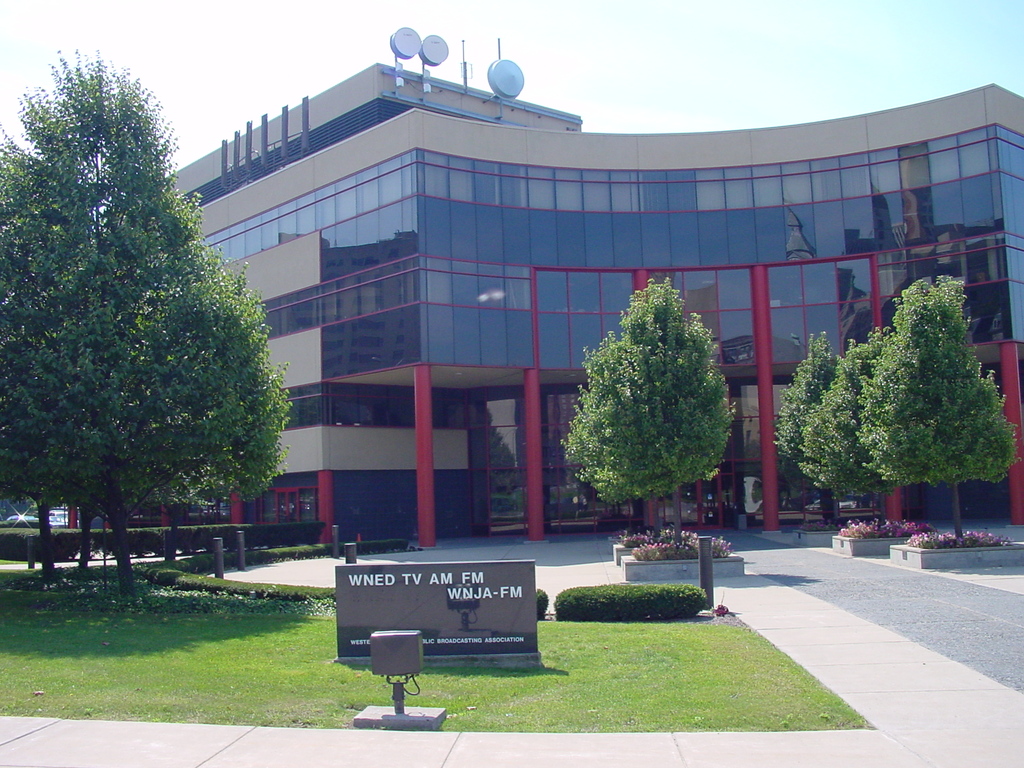 So last January I was a finalist (1 of 2) for Buffalo's WNED (market #52) Program Director. As I scoped out the area by emailing my friend Gabe DiMaio, who worked at WBFO as assistant PD, I found out he was the other candidate! (picture at right is NOT from Buffalo in January, believe me!)
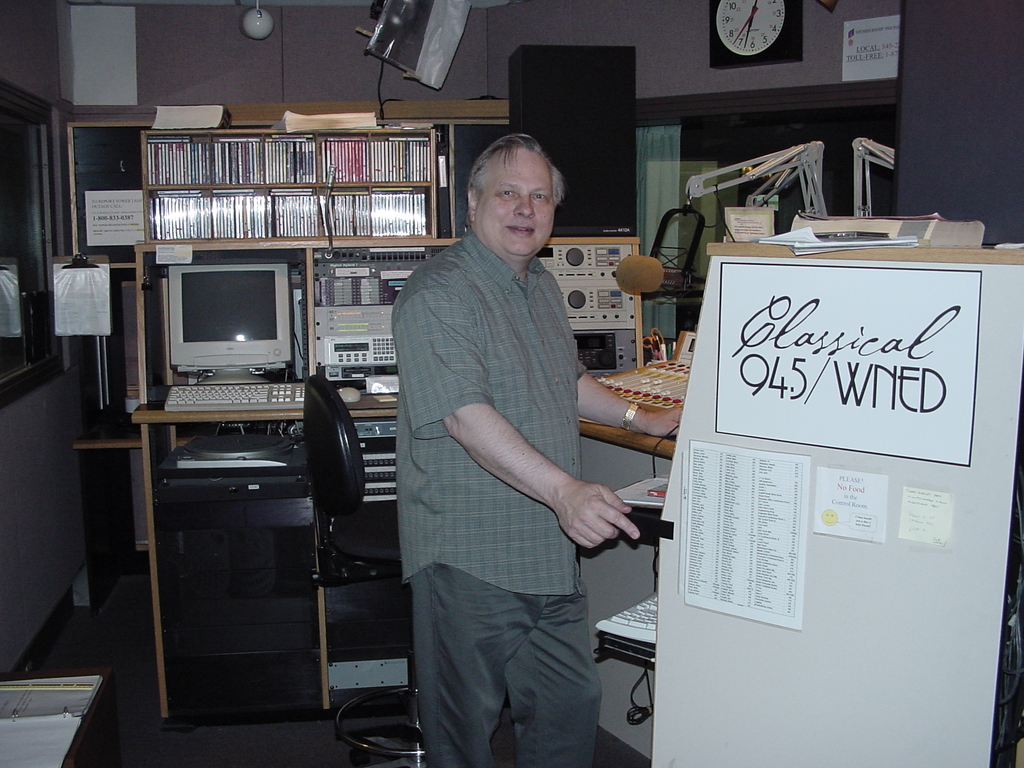 Later in the month, I went up and met the staff and was interviewed, wined and dined. (The studios are seen right with a now former announcer.)


 You'll be glad you did, and then be able to say, oh yeah, I voted for her in round one...and round two, and the finals, and woohoo!


